
From Fritz Müller 1 and 3 October 1866
Desterro, Brazil
Octbr. 1st. 1866.
My dear Sir.
In your last letter (of May 23rd) you wished me to observe whether Oxalis here exhibits different forms.1 I already wrote you that in one of our species I found the relative lengths of the styli and stamens to be variable; I have now satisfied myself that this species is dimorphic.2 In both the forms the stigmas reach to, or project a little beyond, the mouth of the calyx and the longer stamens are fully one third longer than the styli. The shorter stamens in one form are about half as long, whereas in the other they are about as long as the styli.— Thus far the species offers no particular interest; but there is one circumstance which renders it highly curious. At least 99 per cent of the plants of the second form have perfectly sterile anthers, not producing a single pollen-grain. Specimens of this form having all the anthers of all their flowers fertile are extremely rare. There are three different estates of the anthers: with good pollen—with small aborted pollen-grains—and without pollen; they blend into one another by insensible steps; (thus you may find anthers with only two or three good pollen-grains); but notwithstanding they are generally to be distinguished even without the aid of the microscope, the fertile anthers being bright yellow, those with aborted pollen-grains pale yellow and the pollen-less anthers white.3
Now in nine stalks the flowers showed the following combinations of the different anthers:
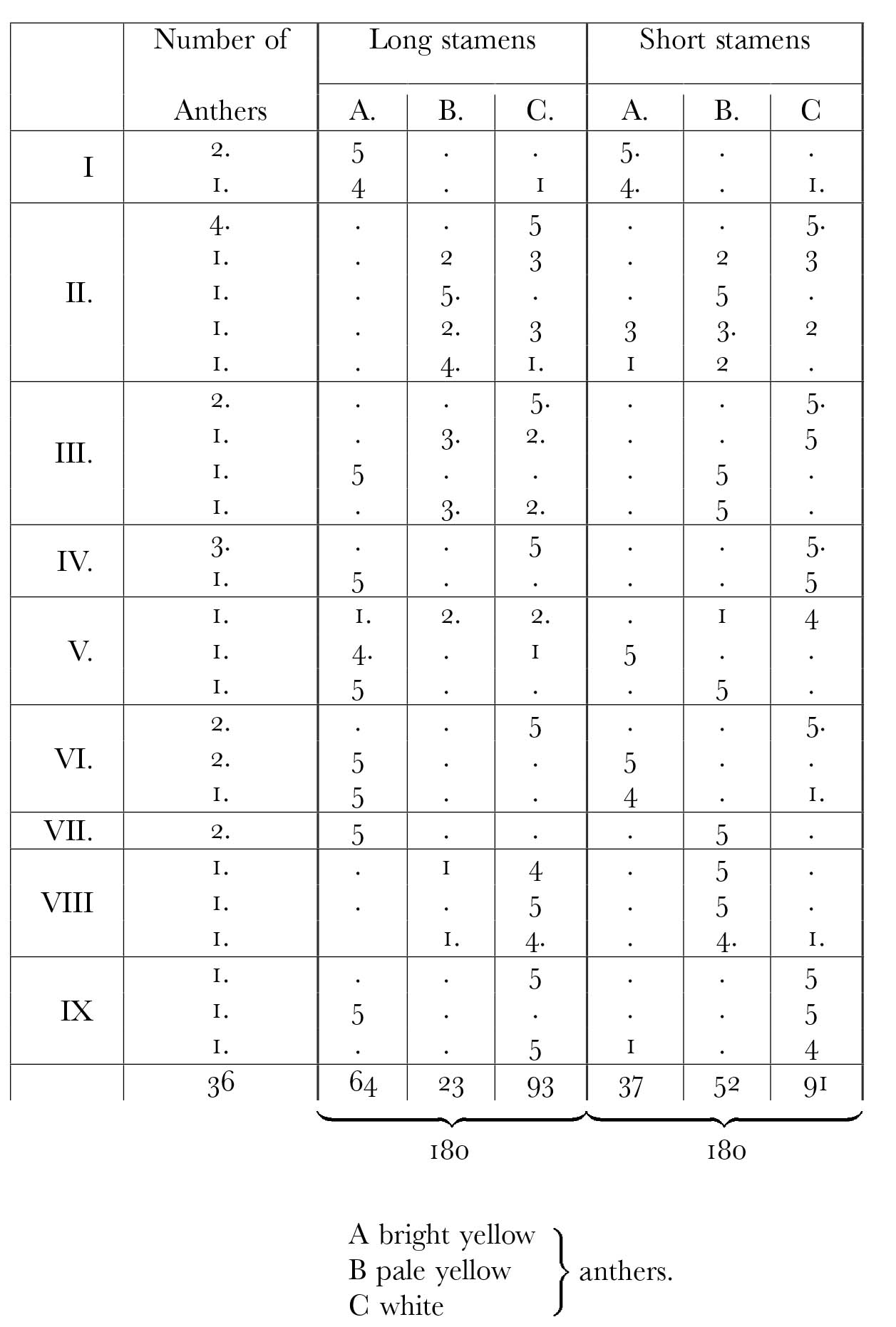
In the first form the anthers are always fertile; but even here, as in the fertile anthers of the second form there is among the good pollen a large amount of aborted pollen-grains.
In some rather rare specimens of the second form,—but only, as far as I know, among those with sterile anthers,—the length of the stamens is very variable; (such were casually the few plants, which I had examined, when writing my last letter).4 Sometimes, in a single flower the longer stamens are hardly as long, and the shorter ones half as long as the styli; but even in those specimens the stamens and styli of the majority of flowers use to show the characteristic lengths of the form.
It is not very rare to find one or two of the white pollen-less anthers transformed into small leaflets, and I met with a single plant, (now in my garden), in which all the anthers are transformed into petala-like leaves, sometimes exceeding ten in number; the ovaries form five open leaves with green stigmas on the tip, but without ovula, and in the midst of these ovarial leaves there is a great number of petala-like leaves, among which sometimes some sepala may be distinguished.5
Although the plant is extremely common (thousands flourishing in the very streets of our town) I have not yet been able to find a single seed-capsule. This sterility may be owing in part to the circumstance of the two forms but seldom growing mingled.6 You may find your way bordered, for a mile or more, by one of the two forms exclusively, which then suddenly is substituted by the other.
A second very common species of Oxalis, with small yellow flowers, is monomorphic, the styli reaching to the level of the longer stamens; this species produces plenty of seed-capsules.7
Of a third species with fine crimson flowers, ressembling in shape, size and colour those of Linum grandiflorum, I have as yet seen only one plant, in which the styli were intermediate in length between the two sets of stamens; although the stigmas of all the flowers were densely covered with pollen, I found no seed-capsules; thus I am inclined to think that it will prove dimorphic or trimorphic.8
In short, I hope to have an opportunity of examining a fourth species of Oxalis with woody stem.—
To the list of dimorphic plants I may add a Cordia, of which I enclose a short- styled as well as a long-styled specimen; as soon as they are ripe, I shall send you seeds of either form.—9
In my last letter (of Aug. 2d) I alluded to the circumstance of brightly coloured seeds remaining attached to the valves of the capsules after their opening.10 I have since found two more plants, in which this is the case. One is a twining Leguminosa, perhaps a Rhynchosia, with black and red seeds. The other is a tree, probably belonging to the Mimoseae, which after the opening of the seed-capsules presents a truly magnificent aspect, being covered over and over with large and elegant curls of pale yellowish silk, (the spirally contracted valves) beset with brilliant red pearls.11
Octbr. 3. Yesterday I procured to calculate the number of seeds contained in a large capsule of an Orchid (Maxillaria?); the seeds weighed 42 grains; I extended half a grain of the seeds into a narrow heap and by counting a small portion I found them to be 20661, so that the capsule would contain the prodigious quantity of 1.756.440 seeds!12
Hoping that this will find you in good health I am dear Sir with the most sincere respect | Yours very truly | Fritz Müller
Do the aërial roots of all the species of Catasetum grow perpendicularly upwards into the air, as they do in our Cat. mentosum?13
CD annotations
Footnotes
Bibliography
Calendar: A calendar of the correspondence of Charles Darwin, 1821–1882. With supplement. 2d edition. Edited by Frederick Burkhardt et al. Cambridge: Cambridge University Press. 1994.
‘Dimorphic condition in Primula’: On the two forms, or dimorphic condition, in the species of Primula, and on their remarkable sexual relations. By Charles Darwin. [Read 21 November 1861.] Journal of the Proceedings of the Linnean Society (Botany) 6 (1862): 77–96. [Collected papers 2: 45–63.]
Forms of flowers: The different forms of flowers on plants of the same species. By Charles Darwin. London: John Murray. 1877.
‘Three forms of Lythrum salicaria’: On the sexual relations of the three forms of Lythrum salicaria. By Charles Darwin. [Read 16 June 1864.] Journal of the Linnean Society (Botany) 8 (1865): 169–96. [Collected papers 2: 106–31.]
‘Two forms in species of Linum’: On the existence of two forms, and on their reciprocal sexual relation, in several species of the genus Linum. By Charles Darwin. [Read 5 February 1863.] Journal of the Proceedings of the Linnean Society (Botany) 7 (1864): 69–83. [Collected papers 2: 93–105.]
Summary
Discusses dimorphism of Oxalis; one form has 99% sterile anthers. Has found three kinds of fertile anthers.
Letter details
- Letter no.
- DCP-LETT-5226
- From
- Johann Friedrich Theodor (Fritz) Müller
- To
- Charles Robert Darwin
- Sent from
- Desterro, Brazil
- Source of text
- DAR 142: 99; DAR 157a: 103
- Physical description
- ALS 4pp inc †
Please cite as
Darwin Correspondence Project, “Letter no. 5226,” accessed on
Also published in The Correspondence of Charles Darwin, vol. 14