
From B. D. Walsh 17 July 1866
Rock Island, Ill. U.S.
July 17, 1866
Chas. Darwin Esq.
My dear Sir,
I sent you by mail last week a short paper of mine exposing some misquotations of Prof. Dana’s, which I hope you have received.1
I received in due course your welcome letter of April 20, & was rejoiced to find that you were preparing a new Edition of the Origin.2 As you are kind enough to promise me a copy, please forward it to me through Baillière 219 Regent St. to Baillière Bros. of New York, with whom I deal, to be sent thence to me by Express.3 The Smithsonian Institution is so awfully slow in their operations, that they quite put me out of patience.4 Curiously enough, the same mail that brought me your last letter brought me also one from Wilson Armistead, saying that he had only just received my box of galls, though I had sent it to the Smithsonian the preceding autumn.5 He was delighted with what I sent, & like Oliver Twist calls out for more.6 I am gathering together another lot for him. I had sent him two bottles of galls packed in common salt brine, by way of experiment, & he says it is a complete success & far superior to alcohol—the chief disadvantage being that it is so vulgarly cheap.
I had a copy sent me the other day of an “Analysis of Darwin Huxley & Lyell, by Henry A. Dubois of New York” being a reprint in pamphlet form from the “American Quarterly Church Review”, which by the way I never heard of before.7 The writer is a beautiful compound of fool & knave & makes some most ludicrous blunders in Natural History; besides accusing you of setting up a new God—yes, a real, personal, omniscient, omnipotent, omnipresent God—called “Natural Selection”.8 Hence, one would infer that you must be a Deist. But when he comes to attack Huxley, he talks of “the atheistical views embraced in Darwin’s hypothesis”; so that you must be Deist & Atheist both at the same time.9 “Throw plenty of mud, & some of it is sure to stick”. My correspondent (Wm. Edwards of N.Y.)10 wanted me to review the review; but I thought it answered itself sufficiently, & that anyhow “the game would not pay for the candle”.11
I believe I have done some little good, at all events among N.A. entomologists, in the way of converting them to the true philosophical faith on the origin of species.12 For I find a great many of them now who take much the same ground as Rev. Herbert,13 but cannot as yet “go the whole hog”, as we say out West.
Have you read Clark’s book on “Mind in Nature”? He strikes me as having almost as illogical a mind as Prof. Agassiz. From one end to the other of the Book I don’t see a single new fact or new argument to carry out his thesis, namely that “Mind” exists in Nature. But, so far as I am a judge, his original investigations seem very valuable.14 I never knew before the history of Agassiz’s treatment of him. It always puzzled me why there was no titlepage to the two first parts of the “Contributions”, but now I fully understand the why & the wherefore.15
You mentioned some time ago the case of a foreign gall-fly having suddenly spread over England.16 Was it not a species that made its gall on the leaf, so that leaf & gall together might be blown great distances by the wind? I have often remarked that our “Oak-apples” are carried by the wind hundreds of yards with the living insect in them; but the species that make their galls in the twig, so that they are part & parcel of the twig itself, infest the same tree year after year, without spreading, except very slowly indeed sometimes, to adjoining trees.
I find that my Paper on Dimorphism in Cynips was reviewed by Dr. Reinhard in the Berlin Entom. Periodical;17 & that he proposes two hypotheses to account for my facts, 1st. that spongifica & aciculata are distinct species, making undistinguishable galls on the same oak, 2nd. that spongifica is an inquiline.18 But my this year’s experiments confirm the fact that aciculata generates spongifica & aciculata indiscriminately; & by next fall I shall in all human probability have facts to show that aciculata (A) generates aciculata (B), & that in the following season aciculata (B) generates aciculata (C), all of them being ♀ ♀ & agamous. I have little doubt now that this process goes on for a considerable number of years in certain species—commonly called agamous—say for 10 or 15 years, until at last a brood of ♂ ♂ appears. This would be altogether analagous to the case of Aphis ♀ producing 8 or 9 broods of ♀ ♀ through the summer by parthenogenesis & finally in the autumn ♂ ♂.19 I am aware that the Germans maintain that the agamous Aphis has no true ovary or “egg-stock” but only a “bud-stock”; but this seems to me a mere verbal distinction. Is it not essential to gemmative reproduction that it should be on the surface of the plant or animal & not in its interior?20
I have the concluding part of my Willow Gall Paper now ready for the press. There are some facts in it respecting Galls that I think will please you, showing that Gall-making insects must have originated according to your theory.21 In the autumn I shall probably throw together the facts respecting Dimorphism in Cynips, which I have been accumulating now for two years.
I discovered this morning that a pale green fleshy gall on the leaf of the Grape-vine, which had been described by Dr. Fitch as Aphidian & referred to the genus Pemphigus, though he was unacquainted with the winged insect, is in reality the work of a Coccus!!! I believe this is the first recorded instance of any species of that family producing galls; at least my books mention none such.22 The gall is about like this
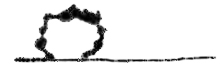 & globular, & occurs very abundantly, some leaves being almost covered with them. Inside there is a true wingless Coccus with a parcel of eggs—say 100—many of which are already hatched out—& no powdery or cottony matter among the young lice, as is always the case with the young plant-lice in galls. Besides, eggs are never found in Aphidian galls, the mother-louse generating viviparously. I wonder if you have any such galls in England.
Yours very truly | Benj. D. Walsh
CD annotations
Footnotes
Bibliography
Agassiz, Louis. 1857–62. Contributions to the natural history of the United States of America. 4 vols. Boston, Mass.: Little, Brown & Company. London: Trübner.
Baillière, Hippolyte. 1853. Catalogue of scientific books. London: Schulze & Co.
Clark, Henry James. 1865. Mind in nature; or the origin of life, and the mode of development of animals. New York: D. Appleton and Company.
Correspondence: The correspondence of Charles Darwin. Edited by Frederick Burkhardt et al. 29 vols to date. Cambridge: Cambridge University Press. 1985–.
Dana, James Dwight. 1866. On cephalization; no. IV: explanations drawn out by the statements of an objector. American Journal of Science and Arts 2d ser. 41: 163–74.
Dickens, Charles. 1838. Oliver Twist; or the parish boy’s progress. 3 vols. London: Richard Bentley.
[Dubois, Henry A.] 1865. The origin and antiquity of man: Darwin, Huxley and Lyell. American Quarterly Church Review and Ecclesiastical Register 17: 169–98, 337–66, 505–34.
Marginalia: Charles Darwin’s marginalia. Edited by Mario A. Di Gregorio with the assistance of Nicholas W. Gill. Vol. 1. New York and London: Garland Publishing. 1990.
Origin 3d ed.: On the origin of species by means of natural selection, or the preservation of favoured races in the struggle for life. 3d edition, with additions and corrections. By Charles Darwin. London: John Murray. 1861.
Origin: On the origin of species by means of natural selection, or the preservation of favoured races in the struggle for life. By Charles Darwin. London: John Murray. 1859.
Post Office London directory: Post-Office annual directory. … A list of the principal merchants, traders of eminence, &c. in the cities of London and Westminster, the borough of Southwark, and parts adjacent … general and special information relating to the Post Office. Post Office London directory. London: His Majesty’s Postmaster-General [and others]. 1802–1967.
Reinhard, Hermann. 1865. Die Hypothesen über die Fortpflanzungsweise bei den eingeschlechtigen Gallwespen. Berliner Entomologische Zeitschrift 9: 1–13.
Sorensen, W. Conner. 1995. Brethren of the net. American entomology, 1840–1880. Tuscaloosa and London: University of Alabama Press.
Variation: The variation of animals and plants under domestication. By Charles Darwin. 2 vols. London: John Murray. 1868.
Walsh, Benjamin Dann. 1864a. On certain entomological speculations of the New England school of naturalists. Proceedings of the Entomological Society of Philadelphia 3: 207–49.
Winsor, Mary Pickard. 1991. Reading the shape of nature. Comparative zoology at the Agassiz museum. Chicago and London: University of Chicago Press.
Summary
On H. A. Dubois’ attack on "Darwin, Huxley and Lyell"
and H. J. Clark’s Mind in nature [1865].
BDW’s work [on Cynipidae].
Letter details
- Letter no.
- DCP-LETT-5159
- From
- Benjamin Dann Walsh
- To
- Charles Robert Darwin
- Sent from
- Rock Island, Ill.
- Source of text
- Field Museum of Natural History, Chicago
- Physical description
- ALS 6pp †
Please cite as
Darwin Correspondence Project, “Letter no. 5159,” accessed on
Also published in The Correspondence of Charles Darwin, vol. 14