
From Bartholomew James Sulivan1 20 October 1838
HMS Arrow Berkley Sound2
October 20. 1838
My dear Philosopher
We arrived here on the 15th. after a twelve days passage from Montevideo & (would you believe it?) had not a breeze that we could call a gale of wind till we were within 60 miles of the Island when being under the Lee we had no sea but a southerly gale with smooth water for two days during which the Thermometer was down to the Freezing point and we felt the cold very severely during the five days we have been here we have had the most beautiful weather I ever saw in any climate. we have not had a shower of rain or any thing more than a moderate breeze & the day after arriving, on my way to one of the High hills to the South of the “Valley of Fragments” I really suffered from the heat & had my face burnt— since then it has been cloudy but today was a beautiful sunny day again. I can hardly believe I am at the Falklands but I have no doubt we shall have our share of the old weather bye & bye. The Barometer has not fallen below 30,10 since we arrived & is now 30,35, a thing I think very unusual here. the Thermometer with the wind moderate from South ranges from 42o at night to 54o in the day. I am afraid I can give you little Geological information for I was so knocked up by my walk to the hill & have felt so much pain since that I have not liked to take much exercise, but I went in a boat the day after to search for that section where you saw the sand stone turning up in Clay slate. I landed & searched every cliff between the settlement & the fish house creek but could not find the place, but on Monday I will search the side of Fish house Creek (we are now in Johnson’s Harbor) & will do all I can to find it. I have begun to make a little section of every range I cross and I will try and colour a chart at each place I go to, as it may be of use, but I expect I shall be able to add nothing to what you saw; I sat on a rock overlooking the Fragments for some time & tried to form Theories by whole sale but they all ended in smoke, but I think there is evidently some connection between them & the cliffs on the Summits of the Hills overlooking the valley as the large stream in the valley is certainly connected by small lateral streams with the Fragments now falling from the cliffs I will try & explain this by a splendid section
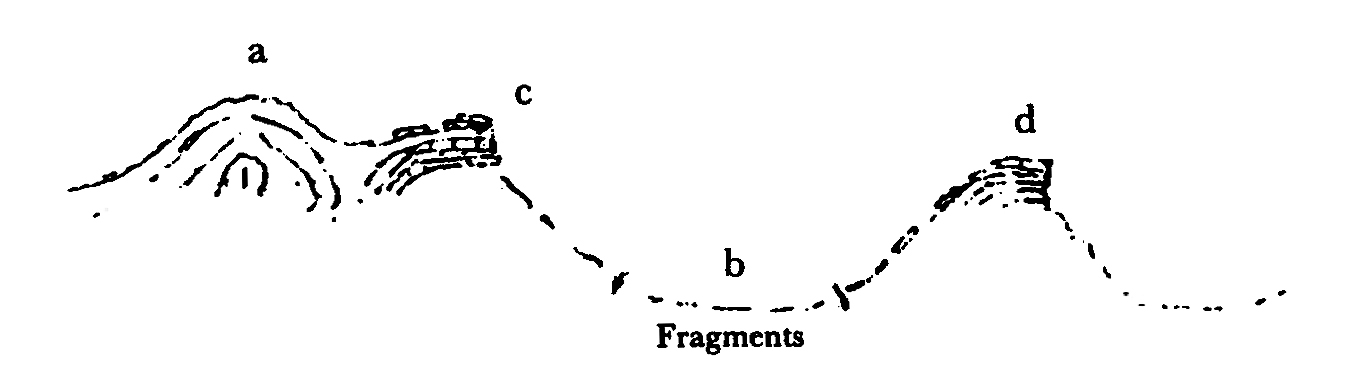
(a) is the range South of Berkley sound and on one side a complete section is exposed which makes it appear to be dipping from a center to all points, but perhaps I may have been deceived, in the same hill there is evidently another line of elevation South of the Summit which forms in most places steep cliffs with piles of castelated shale. Dipping towards the Summit of the hill, directly South of these cliffs (c) is the valley of Fragments I speak of (b) South of which is a high Conical Hill also dipping to the Northd. (d) now the cliff (c) is evidently falling away & the Fragments are strewed thickly high up the slope now I will try to show what I mean by lateral streams
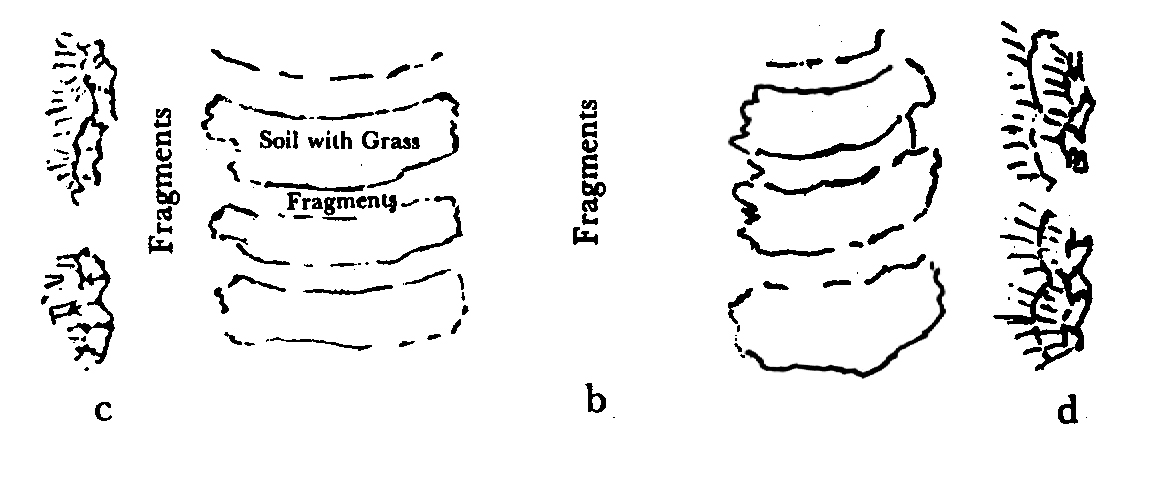
it appeared to me as if the valley from Hill to Hill was one mass of Fragments on some spots of which some shrubs & moss had grown up & covered the Stones, leaving narrow strips of Fragments which seemed all curved one way and looking from the Hill the curves seemed as regular as the waves of the Sea beach. now I daresay you know all this but as I do not recollect it in your description I mention it in case any thing more may strike you from it another thing struck me which was that the large stream of stones seemed slightly rounded on their edges by running water but evidently not by rolling over as some slight projecting portions on many stones must have been knocked off. The stones in the small lateral streams seemed more waterworn than those in the valley till near the top of the Hill where they were not worn the least. unfortunately I have not your book3 here now as I left it with my Father4 for him to read it & he will bring it to me in the Stag. Some of the Quartz rock was so speckled by some dark mineral (I suppose mica) that I should almost have supposed it to be a fine grained Granite. I hear from one of the officers of the Sparrow that near Falkland Sound on this Island the slate exactly resembles the roofing slate in England and he says it is just as good.
I tried to get a line of Soundings down the coast of Patagonia but after passing Cape Corientes the Wind from the Northward forced us off the bank & we never regained it again tho we stood in for the land whenever the wind got to [ N] W but before we could reach soundings the wind drew to West[ N] W & prevented our getting any closer so that the first place we struck soundings was off the NE end of the Falklands in 73 faths about 60 miles off. the bottom was very fine sand nearly black but several little white specks in it which I think with the small power glass I have appear to be Tiny agate Pebbles but when I return you shall see them yourself not that I suppose it will be of any use I hope your work goes on cheerily & that you are in a fair way of following my example on one point that you may have some one to keep you company during your solitary life. you may depend it is the best thing you can do but never after let any thing separate you if you really feel any affection for each other5
God bless you my dear Friend | & Believe me | Sincerely Yours | B J Sulivan
CD annotations
Footnotes
Bibliography
DNB: Dictionary of national biography. Edited by Leslie Stephen and Sidney Lee. 63 vols. and 2 supplements (6 vols.). London: Smith, Elder & Co. 1885–1912. Dictionary of national biography 1912–90. Edited by H. W. C. Davis et al. 9 vols. London: Oxford University Press. 1927–96.
Summary
Reports arrival at Falklands; weather conditions, and unsuccessful search he made for a geological formation CD had seen. Describes cliffs, streams, rocks, and lines of elevation; includes two drawings.
Letter details
- Letter no.
- DCP-LETT-429
- From
- Bartholomew James Sulivan
- To
- Charles Robert Darwin
- Sent from
- HMS Arrow , Berkeley Sound
- Source of text
- DAR 39: 18–19
- Physical description
- ALS 4pp †
Please cite as
Darwin Correspondence Project, “Letter no. 429,” accessed on
Also published in The Correspondence of Charles Darwin, vol. 2