
From Daniel Oliver 14 April 1863
Royal Gardens Kew
14.IV.1863
My dear Sir
Let me beg you never to apologize. I feel so utterly unable to help you in any way unless it be about these little questions.1
The ovule of Primula is amphitropal, or what Agardh wd. call apotropo-amphitropal I suppose.2
Here it is.
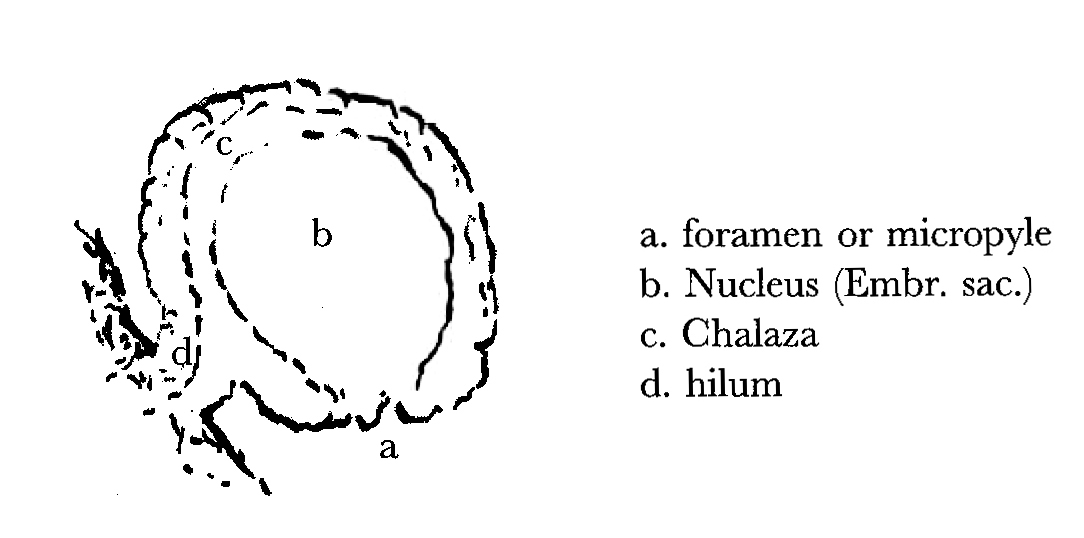
It is all but anatropal If the funicle were adnate quite down to the micropyle then it wd. be so.3
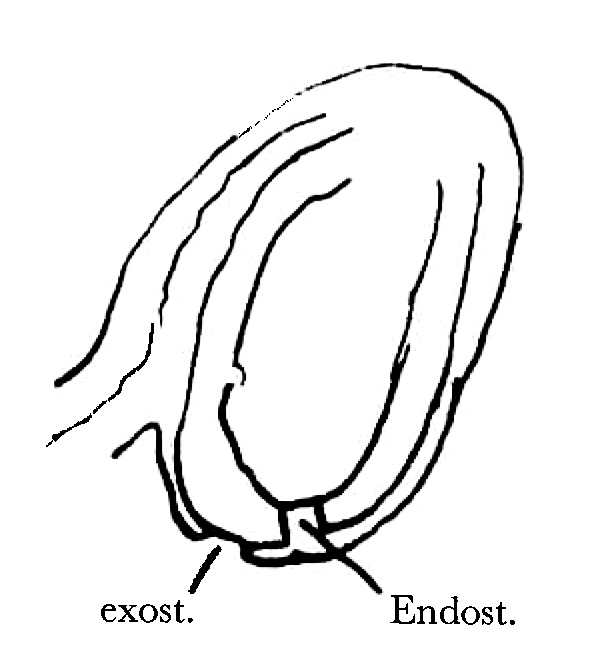
Hofmeister says Primulaceae differ from the great majority of micropetalous plants in having 2 coats to their ovules.4 They have generally but 1 coat.
The inner is thick, the outer very thin. He says the exostome (opening through the outer coat) “liegt vom Endostom (openg. thro’ inner coat) eine Strecke nach der Raphe hin entfernt; der Pollenschlauch hat von jenem zu diesem ein Stück zwischen beiden Eihüllen hinzukriechen”—5 This is a very curious observation. The openings appear thus not to coincide.
What you say is very curious about pollen-tubes penetrating ovules.6 I do not remember any case of direct action except of course the normal place in Gymnosperms.
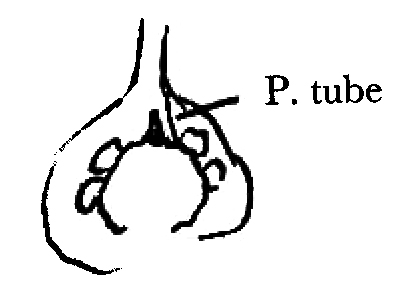
A good part of a notice of Welwitschia in N.H.R. I gave to the question of this Gymnospermy.—7 I have made drawings from the very interesting Primulas you kindly sent,8—but they do not (seem to me to) furnish decisive evidence against Caspary.9 I am not sure as to direction taken by the tubes but from what I see in an ovary now before me of Primrose think they do not go the round-about way down the sides of the cavity—& up the placenta, but that they strike right upon the top of it near the side of the spear-process from its centre. It must surely be so.
We expect Dr. Hooker anytime.— Today I daresay.—10 The opening at the Chalazal end is something astounding!—11
Ever very sincerely yours | D Oliver
I have re-opened this to say Dr. Hooker is not coming until Friday. Lady H. told me a few days ago his tour had been quite successful so far.12 I have looked further at ovary of Primrose & the tubes land right upon the placenta & do not trouble to go down & up again—at least I dont see them do so,—tho’ they must creep down by each ovule to get to its micropyle—13
Yrs | D O
Footnotes
Bibliography
Agardh, Jacob Georg. 1858. Theoria systematis plantarum; accedit familiarum phanerogamarum in series naturales dispositio, secundum structuræ normas et evolutionis gradus instituta. Lund, Sweden: C. W. K. Gleerup.
Caspary, Robert. 1861. Vergrünungen der Blüthe des weissen Klees. Schriften der Königlichen Physikalisch-ökonomische Gesellschaft zu Königsberg 2 (1863): 51–72.
Desmond, Ray. 1994. Dictionary of British and Irish botanists and horticulturists including plant collectors, flower painters and garden designers. New edition, revised with the assistance of Christine Ellwood. London: Taylor & Francis and the Natural History Museum. Bristol, Pa.: Taylor & Francis.
Hofmeister, Wilhelm Friedrich Benedict. 1858. Neuere Beobachtungen über Embryobildung der Phanerogamen. Jahrbücher für wissenschaftliche Botanik 1: 82–188.
Hooker, Joseph Dalton. 1862d. On Welwitschia, a new genus of Gnetaceæ. [Read 16 January and 18 December 1862.] Transactions of the Linnean Society of London 24 (1863–4): 1–48.
OED: The Oxford English dictionary. Being a corrected re-issue with an introduction, supplement and bibliography of a new English dictionary. Edited by James A. H. Murray, et al. 12 vols. and supplement. Oxford: Clarendon Press. 1970. A supplement to the Oxford English dictionary. 4 vols. Edited by R. W. Burchfield. Oxford: Clarendon Press. 1972–86. The Oxford English dictionary. 2d edition. 20 vols. Prepared by J. A. Simpson and E. S. C. Weiner. Oxford: Clarendon Press. 1989. Oxford English dictionary additional series. 3 vols. Edited by John Simpson et al. Oxford: Clarendon Press. 1993–7.
[Oliver, Daniel.] 1863. [Review of J. D. Hooker’s study of Welwitschia.] Natural History Review n.s. 3: 201–11.
SBL: Svenskt biografiskt lexikon. Edited by Bertil Boëthius et al. 33 vols. and 4 fascicles of vol. 34 (A–Swenson) to date. Stockholm: Albert Bonnier and P. A. Norstedt. 1918–.
Summary
The ovule of Primula is amphitropous or what J. Georg Agardh calls apotropo-amphitropous [see Theoria systematis plantarum (1858), tab. 24, fig. 5–6].
Letter details
- Letter no.
- DCP-LETT-4093
- From
- Daniel Oliver
- To
- Charles Robert Darwin
- Sent from
- Kew
- Source of text
- DAR 173: 21
- Physical description
- ALS 6pp
Please cite as
Darwin Correspondence Project, “Letter no. 4093,” accessed on
Also published in The Correspondence of Charles Darwin, vol. 11