
From Daniel Oliver 10 April 1862
Richmond, SW.
10. IV. 1862
My dear Sir.
It is very atrocious of me to trouble you especly. that I gather from Dr. Hooker that he thinks you may be unwell.1 But you must not on any acct. reply to me until it is perfectly convenient. Surely you were observing Fumariaceæ some time ago.2 Now I wonder however if (the flower of Fumarae.) can be fertilized by foreign pollen. By other than the pollen of its own stamens. Many other plants might be named in same cate⟨gory⟩
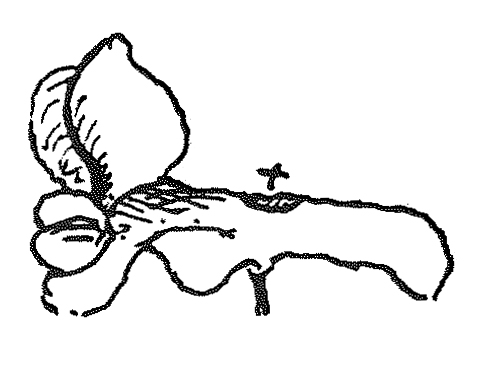
⟨ ⟩ common one & I saw a few days ago that the insects had bored a hole at x thus getting at the nectar without disturbing the anthers which instead fit very closely under the stigma x x x
They wished me to notice your case of Primula dimorphism in Nat. Hist. Review & I thought of giving a short acct. of some cases of the phenomenon so far as we know anything abt. it,—as in Viola, Oxalis, &c.—3 And the case of such plants as the Corydalis, &c. occurred to me apropos of the thing.— I was showing Dr. Hooker & Mr. Lubbock the 2 forms of Primrose the other day which confirmed the admirable accuracy of yr. obs. upon them4 Besides the differences in pollen, stigma, &c.—you might notice (perhaps indeed you say so, but I do not recollect it) that the ovules of the long-styled are considerably larger (& probly. less numerous) in the bud than in the short-styled plant even when expanded.—5
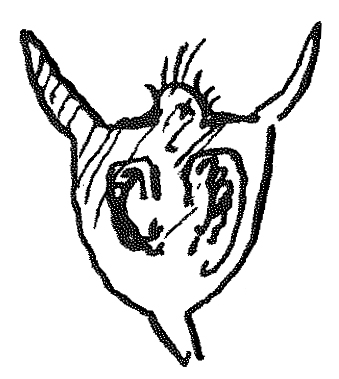
| No Corolla, no apparent stamens No—style or stigma,—but with ovary & numerous ovules. |
|
x is a hairy mammilla sticking slightly up in middle of disk Dissecting further I found the disc membrane double in the middle the interspace enclosing a stigma-like body:—thus—
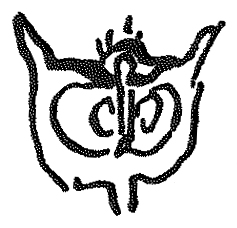
In the minute flowers,—(size of coriandras to pea), it was at first difficult to understand, but I now find that the stigma-like body enclosed by imperforate membrane—is both stigma & anthers. Looking down upon it after dissecting away upper membrane I find it, in the large flowers 5-lobed—with slender rays from the tips of the lobes to base of each calyx-lobe thus—
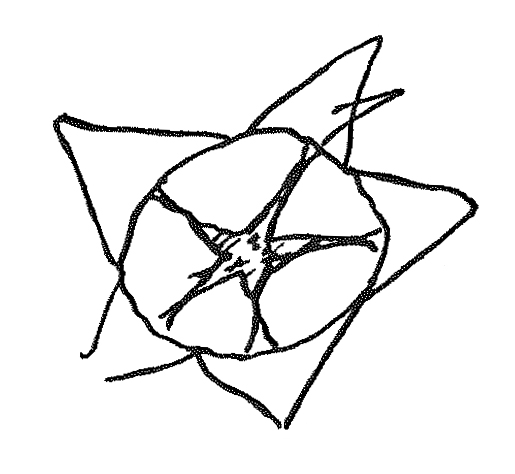 the ends of the rays are attached.— Further examining & comparison shows satisfly. that there are stamens closely connate over a stigmatic body. In flowers of larger size,—approaching normal conditions—I find the stigma raised in short style (it is rather long normally) & the membrane (which represents the corolla) ruptured—or rather not closed over it.— Now I have not means at hand to ascertain certainly just now but do not doubt but that the small flowers do perfect seed, tho’ the ‘flowering’ takes place (one wd. think) where ‘crossing’ was out of the question. I thought of giving a little drawing or two of it to Linn: Soc. as I can make time before my lectures,—calling attention to it.—8
By the way I think I cd. get you some Primula farinosa this season if it wd. be useful to you.— If you wd. care in the least for it,—if you’d kindly spare me a duplicate of your Primula paper I wd. lend it to a person (whom I do not know personally) living very near heaps of the plant, & dont doubt he wd. try to send a box.—9
Yours very Sincerely | Dl. Oliver
CD annotations
Footnotes
Bibliography
Correspondence: The correspondence of Charles Darwin. Edited by Frederick Burkhardt et al. 29 vols to date. Cambridge: Cambridge University Press. 1985–.
‘Dimorphic condition in Primula’: On the two forms, or dimorphic condition, in the species of Primula, and on their remarkable sexual relations. By Charles Darwin. [Read 21 November 1861.] Journal of the Proceedings of the Linnean Society (Botany) 6 (1862): 77–96. [Collected papers 2: 45–63.]
Forms of flowers: The different forms of flowers on plants of the same species. By Charles Darwin. London: John Murray. 1877.
Linnaeus, Carolus (Carl von Linné). 1792. Prælectiones in ordines naturales plantarum. Hamburg.
Summary
Now believes flowers of Fumariaceae must be self-fertilised.
Planning a piece on dimorphism in the Natural History Review ["On the two forms, or dimorphic condition, in the species of Primula … by Charles Darwin", n.s. 2 (1862): 235–43].
Observations on Campanula dimorphism.
Letter details
- Letter no.
- DCP-LETT-3502
- From
- Daniel Oliver
- To
- Charles Robert Darwin
- Sent from
- Richmond
- Source of text
- DAR 173.1: 13
- Physical description
- ALS 5pp †
Please cite as
Darwin Correspondence Project, “Letter no. 3502,” accessed on
Also published in The Correspondence of Charles Darwin, vol. 10