
From Frederick Smith 26 February 1858
Brit Museum
26th. Feby. 1858.
My dear Sir
Your ant with the bright red head is as you suspect the F. sanguinea—the other is F. rufa.1 Sanguinea may be known readily by examining the facial area which is dull or semiopake— in F. rufa it is ⟨ ⟩sing & more angulated—
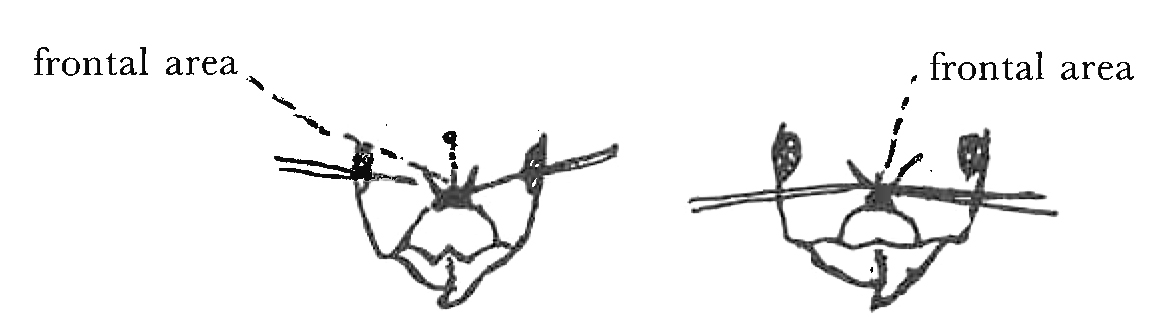
I should think it is rather too early for predatory attack, when I saw a foray of the kind it was when the nest of F. nigra had pupæ of workers in it—2 just now I suspect only larvas or pupas of males & female are to be met with—you will have the best chance Morng or Eveng. during the ⟨rest⟩ of the day, you will not see anything of the kind—a dull day is as good as Morng or Eveng.— 3
I have before me a comb of a Sps. of Polistes,4 and in this as in all combs in which a separate foundation is laid for each cell—the hexagonal form rises from a cup-shaped foundation5 so that the origin of each angle begins at the same point of the curve and therefore if the cupshaped base is removed—the basal edge must be
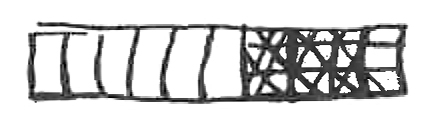 in nests of some Brazilian wasps. (Polybia)—the first comb is protected by an outer covering thus—
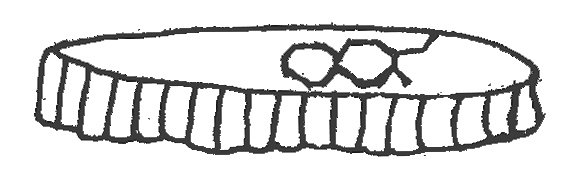 on this covering the next layer of cells are built and here I have seen hexagonal bases to the cells, the walls rising at once perpendicular from the angles6
believe me, yours f⟨aithf⟩ully | Fredk ⟨Sm⟩ith
CD annotations
Footnotes
Bibliography
Natural selection: Charles Darwin’s Natural selection: being the second part of his big species book written from 1856 to 1858. Edited by R. C. Stauffer. Cambridge: Cambridge University Press. 1975.
Smith, Frederick. 1854. Essay on the genera and species of British Formicidæ. [Read 4 December 1854.] Transactions of the Entomological Society of London n.s. 3 (1854–6): 95–135.
Smith, Frederick. 1857. Revision of an essay on the British Formicidæ, published in the transactions of the society. [Read 7 December 1857.] Transactions of the Entomological Society of London n.s. 4 (1856–8): 274–84.
Summary
Identifies an ant described by CD and discusses the predatory habits of Formica sanguinea.
Describes some wasps’ nests.
Letter details
- Letter no.
- DCP-LETT-2226
- From
- Frederick Smith
- To
- Charles Robert Darwin
- Sent from
- British Museum
- Source of text
- DAR 177: 191 (fragile)
- Physical description
- ALS 4pp damaged
Please cite as
Darwin Correspondence Project, “Letter no. 2226,” accessed on
Also published in The Correspondence of Charles Darwin, vol. 7