
To John Lubbock [1 November 1856]1
Down
Sunday
Dear Lubbock
I have written to Hooker to enquire. The case has been described in Linn: Transactions.—2 Many of Spallanzanis experiments seemed to show that plants have been produced without pollen;3 but the subject has been discussed backwards & forwards of late years,—& largely by Gærtner in his Beitrage zur Kenntniss &c.4 But I cannot possibly spare this Book for about a fortnight. for I am using it daily.5
I think your explanation of the inner saddle perfectly satisfactory; it is in fact Continuous with inner membrane of carapace, like the outer saddle is with the outer membrane of carapace.—
But I demur vehemently to your calling the under membrane of carapace “Corium”6
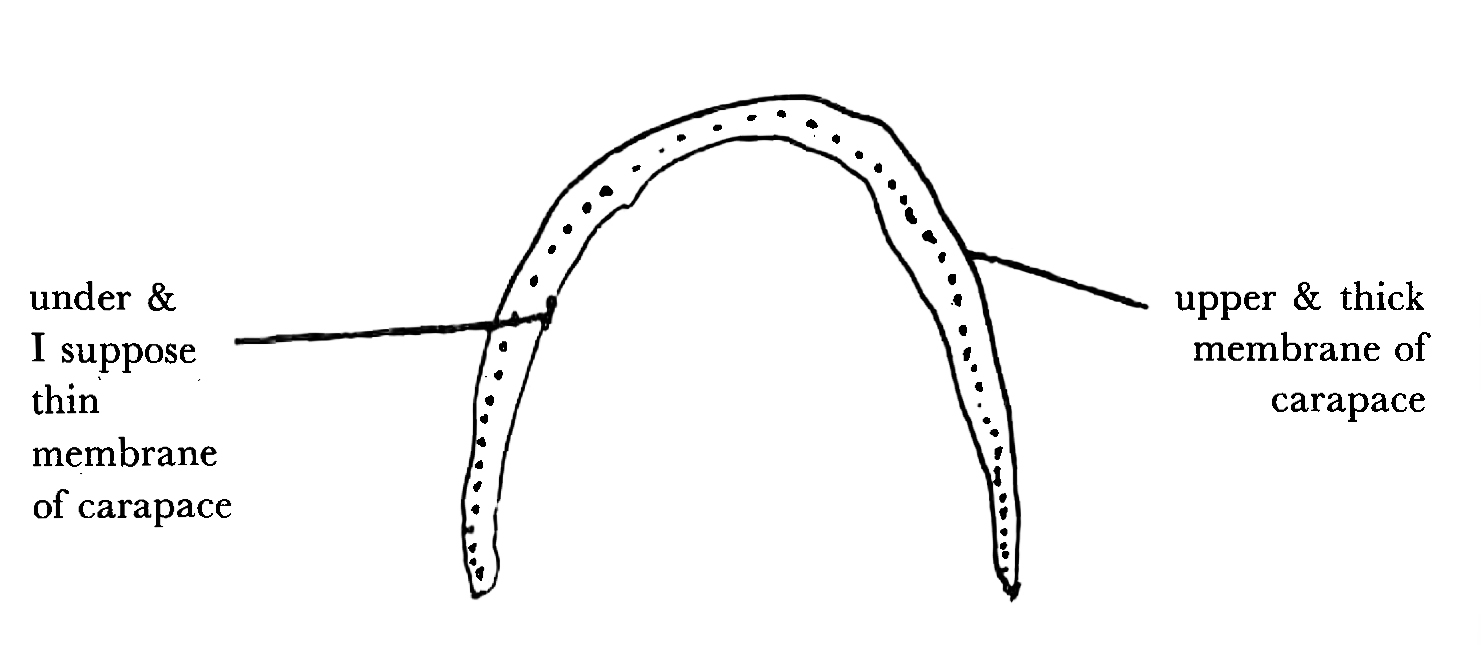 The “corium”, I apprehend, wd be represented by the dotted line between these two membranes, & at each moult, would form a new upper & a new under membrane. Corium or true skin will never, I imagine, be freely exposed to water or air; its very nature, I apprehend, is to be covered with epidermis or chitine membrane, which it generates at each fresh moult.—
Your’s very sincerely | C. Darwin
No doubt the corium itself is double or a fold
Would not longitudinal section of posterior end, together with tranverse section make things clearer?.—7
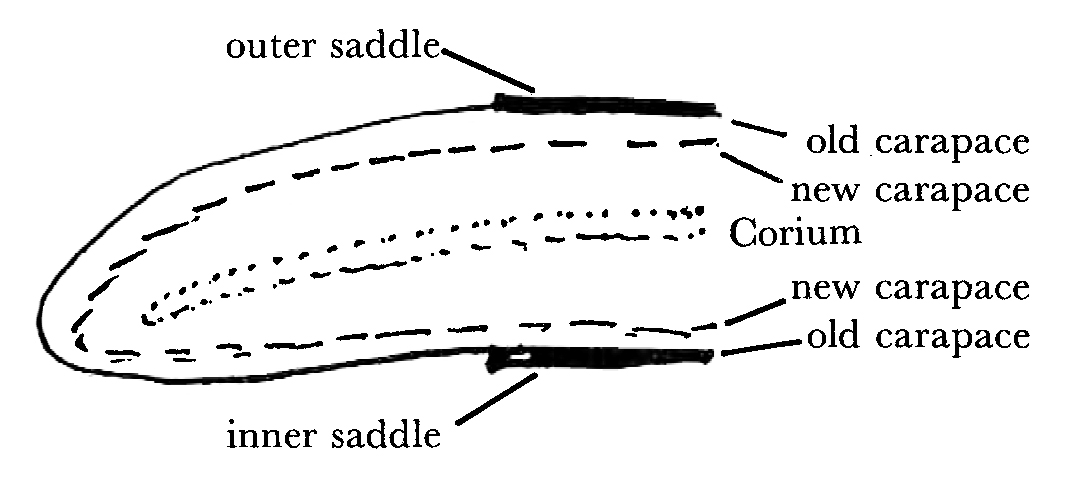
This would show how both inner & outer saddle were moulted together. You could give true outline longitudinally of carapace.
Footnotes
Bibliography
Correspondence: The correspondence of Charles Darwin. Edited by Frederick Burkhardt et al. 29 vols to date. Cambridge: Cambridge University Press. 1985–.
Gärtner, Karl Friedrich von. 1844. Versuche und Beobachtungen über die Befruchtungsorgane der vollkommeneren Gewächse und über die natürliche und künstliche Befruchtung durch den eigenen Pollen. Pt 1 of Beiträge zur Kenntniss der Befruchtung der vollkommeneren Gewächse. Stuttgart: E. Schweizerbart.
Natural selection: Charles Darwin’s Natural selection: being the second part of his big species book written from 1856 to 1858. Edited by R. C. Stauffer. Cambridge: Cambridge University Press. 1975.
Smith, Charles Hamilton. 1841. Horses. The Equidæ or genus Equus of authors. Vol. 12 of Jardine, William, ed., The naturalist’s library. 40 vols. Edinburgh. 1833-43.
Spallanzani, Lazzaro. 1769. An essay on animal reproductions. Translated from the Italian [by M. Maty]. London.
Summary
Discusses arthropod structure and the nature of the corium.
Letter details
- Letter no.
- DCP-LETT-1980
- From
- Charles Robert Darwin
- To
- John Lubbock, 4th baronet and 1st Baron Avebury
- Sent from
- Down
- Source of text
- DAR 263: 5 (EH 88206454)
- Physical description
- ALS 4pp diag
Please cite as
Darwin Correspondence Project, “Letter no. 1980,” accessed on
Also published in The Correspondence of Charles Darwin, vol. 6