
From Edward Blyth [c. 22 March 1856]1
Notes for Mr. Darwin.
Have you studied yet Bocharts great work? More especially Vol. 2 of his ‘Omnia opera’, where fowls and Pigeons are treated of.2 If you have not, do so; albeit there seems to me a vast deal of uncertainty respecting the correct application of many of the names. As regards fowls, I see that Capt. Allen’s notice of feral fowls in the isle of Annobono has been made the text of a paper read before the Académie des Sciences, on Octr. 29th. last; which see. 3 I have not Allen’s work now by me; but there is something very suspicious in the Frenchman’s words—“Les Poules d’Annobono resemblent aux Pintades”.—4 By reference to my paper on a zooll. collection, from the Somáli country, you will see that a kind of Francolin is considered “the wild hen” east of the Red Sea;5 & in the S. of Arabia, Chesney talks of “Jungle-fowl” & “Pheasants”.6 Bosh of course! Guinea-fowl there are (N. ptilorhyncha?), as long ago stated by Niebuhr,7 and latterly by Dr. Nicholson in P. ZS. 1851, p. 128;8 and here I may remark that Dr. N’s supposed new Francolin (Fr. yimensis) is evidently the Perdix melanocephala of Rüppell, a species of Caccabis (or red-legged P.), not a Francolin! Among the birds of almost general distribution, bear in mind Squatarosa helvetica.9 I hear that there is a good collection of skins of Arabian birds in the Bombay museum, and have accordingly written thither to make enquiries about these Gallinaceæ of S. Arabia. I have just recd. a large batch of the Proc. Z. Soc.; and find a Gallus Temminckii described by Gray (& it would seem also figured).10 I have no faith in it; suspecting it very strongly to be a hybrid of some kind,11 probably a cross between male varius (v. furcatus) and hen of the large Malayan breed of domestic fowls; while G. œneus, Tem., as we are assured by Schlegel, is mixed varius & (small?) common hen.—12 Owen, I see, has been identifying a skull found in the S. of England with the ‘Musk Ox’ of the Barrengrounds of Arctic America!13 Good! He before had Rein Deer from Devon; & these serve as additional evidence for Agassiz’s glacial period: but whatever does Owen mean by calling it the “Musk Buffalo”? Bubalus moschatus!!! Beyond a certain resemblance in the flexure of the horns to B. caffer, it seems to me about the furthest remove from the true Buffalos of all the Bovines; & it has the ovine nose, & I believe 2 teats only; but the former the Yak also has, in reference to climate,—also the Rein Deer! Buffalos proper are creatures which pass much of their lives in water, with just the eyes & nostrils above the surface, have thick & scantily clad pachydermatous hides, & feed on coarse aquatic plants in the hottest climates!!! The style of animal too, is altogether dissimilar; judging from what looks to be a capital portrait of the ‘Musk Ox’, published by one of the Arctic navigators, somewhat thus (from memory on my part),
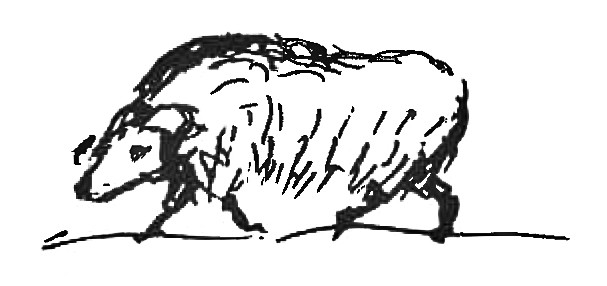 or with the head still more hanging, if possible: the characteristic attitude of all the true Buffalos is with the head held out straight: observe too the short tail of the Ovibos; but jam satis—
At last I have fairly taken up the subject of domestic Pigeons; & shall send you many living specimens, if not some that will carry high prizes as novelties in England; What particularly interests me is, that I have already obtained nearly all the distinct races procurable here, of the typical or wild colour, i.e. slaty, with 2 black bars on wing, &c. Would not a fantail of that hue be a novelty in England? Well, the common wild blue Pigeon of India (intermedia of Strickland)14 chiefly differs from the European livia in having no white on the rump; & I find that the typically coloured carriers here are white-rumped, & therefore probably of European extraction; whereas all the other races which I have seen typically coloured as yet, have ashy rumps, & are therefore probably of Asiatic (not Indian) origin!15 Whether ‘fancy Pigeons’ are bred by the Chinese, I have not yet been able to ascertain, but will do so! If so, probably only of late years, & chiefly about the foreign ports: for I cling to the suspicion that to the old Semitic civilizations of W. Asia, we are indebted for these curious products of domestication and careful breeding. I now more than ever suspect that ‘fancy pigeons’ were unknown in India prior to the Muhammedan conquest! For there appear to be no Sungskrit names denoting the different races; and in Kamandáki’s ‘Elements of Polity’, a work of the 3rd. Century B.C., there is no mention made of curious Pigeons, although it notices almost all animals brought to the use of man at that time, so far of course as known to the author. Moreover Kamandáki notices tame fowls, but says nothing of different breeds of them;16 and the domestic fowl is prohibited to be eaten, although the wild is permitted, so long back as by Mánu, or 12 Centuries B.C. (according to Sir W. Jones);17 and therefore tame fowls were familiarly known so far back in this country!18 Mind that you keep a good look out among the Assyrian monuments— Also consult H. H. Wilson, Rawlinson, & others.19 Looking over Dixon’s book on Pigeons, I observe an interesting extract concerning the breeding & rearing of young Cormorants in China.20 And now about our Indian breeds of Pigeons. In general, each is to be had both bare-legged and feather-legged; & the latter divide into those which have long feathers growing from the outer side of the toes, & those which have the shank feathered—but few or no plumes on the toes. All three such varieties of fantails are to be had, and each with an occipital toupet; & there are also fantails with smooth occiput, as I think are all those of England. Those fantails, however, with long feathers on toes are rare and somewhat difficult to obtain, and all such that I have seen yet are parti-coloured. The others are commonly pure white, or parti-coloured; sometimes black, brown, or ashy; and there is a strong tendency to have the tail black or ashy, while all the rest (save a patch on each flank) is pure white! I have obtained an oddity of this kind, which is a most strange looking bird, as it struts about, with its black tail spread over the back so as to meet in front, and the neck thrown back, & head perking out from behind, or where the tail ought to be! I have also obtained one typically coloured fantail, slaty with bars on wing, but with the blemish of some white feathers on one wing. I am trying to mate both, and ere long shall succeed no doubt. Would not pure white fantail with black tail be a novelty in England? And still more those with long feathers on toes, & occipital toupet also? Likewise the following, termed Parpaun. A handsome medium-sized Pigeon, with very long feathers on toes, and very proud (remarkably fine) occipital crest of reverted feathers, with a whorl on either side of the crest— Colour pure white, or dark cinnamon, or black (finely iridiscent on neck), or normal, or (of course) parti-coloured. Have you such a Pigeon in England?— Another is somewhat larger (on the average), with same variety of colouring, & long feathers on toes, but smooth occiput, & some carunculated skin round eye,—also a very handsome Pigeon. The Lotun or ground-tumbler has little to distinguish it, save an occipital toupet, & shank feathered way down. Often white, or variously pied. I have obtained one white with black crown & tail! The Powters seem to resemble those of England; but I have not hitherto met with fine specimens, with long feathers on toes, such as I remember in England. The Suragie (or Shirazi, from Shiraz in Persia,) is a Runt, always bred to have the throat (forehead & cheeks sometimes), front of neck, underparts, rump & tail, pure white, the rest of any uniform colour, as black, ruddy, slaty, or delicate pearl-grey (like Larus argentatus or even L. glaucus), bare-legged, or with feathers more or less, but I have never seen long feathers on the toes. These ought to be very large; but the common run are not particularly so, though specimens of astounding size are bred at Lucknow, Delhi, &c., & these sell at high prices. Carriers (termed Oran) are distinguished by their general figure, long bill, strong feet (with short feathers occasionally), & more or less caruncle around eyes & at nostrils, sometimes enormously developed.— Colours black, &c, & often normal (but with white rump). A sort of Bald-pate is common, & is a pretty Pigeon, remarkably true to its colouring, which is black with fine reddish-purple glosses, with contrasting white cap & 2 or 3 primaries on each side, & feet generally bare, though sometimes with short plumes, in which case those on toes are often white: an occipital toupet, & a sort of hood. Some have the dark parts ruddy, more or less pale. These Baldpates (termed Mukkhi) are also a good deal distinguished by their manners; they are particularly active, & saucy towards other Pigeons; & they shake the head, somewhat like the ‘broad-tailed shaker’ or fantail. This is the only race which I have not seen with the wild colouring. Sky-tumblers (Gira-baz) I have not seen much of as yet; but they seem to = the European; but unimproved. Turbits and Jacobins I do not remember to have seen.— I think the irides vary in colour in every breed, “pearl”, “gravelly”, &c; but I have not hitherto paid sufficient attention to this matter.21 I purpose attempting several curious crosses, to mark the results. Have you been trying experiments of this kind?22
—March 22/— Since last writing, it has struck me that our wild Pigeons (intermedia) have dark feet, whereas the tame have generally pink feet; but though I have 4 times crossed the Calcutta esplanades, going & coming to the museum, I have not, strange to say, seen a single flock; though they are generally there numerous, & keep rising before the horse, & settling again just in the way, doz. times in succession. This “important observation” must now, therefore, be deferred for a future opportunity.—
I suppose, ere this reaches you, that you will have read my article on wild Asses.23 Strange to say, the very day of its publication, the subject was engaging the attention of the Académie des Sciences in Paris, as I see by the Comptes Rendus; on the occasion of the presentation of two animals from the Syrian desert (as you will see by a note), which Is. Geoffroy distinguishes as a new species, E. hemippus, & I think he is quite right.24 But my suspicions are confirmed regarding the indigenous abode of the Ass; and I now feel satisfied that it is an African rather an Asiatic quadruped! Nor do I see what reason the Prince Canino can find for pronouncing the troops which range the deserts & also mountains of N. E. Africa, to be descendants of tame Donkeys (like the S. American);25 seeing that they are of pre-historic antiquity; & moreover that the finest breeds of tame Donkeys inhabit now (as from the remotest traceable period) the adjacent countries, and, as a general rule, degenerate as we recede from them. I also now suspect that Chesneys “wild Horses” in N. Arabia refer to the hemippus, & his “wild Asses” in S. Arabia to asinus ferus (vel Onager),26 also that Wellsteads Sacotran “wild Asses” are asinus aboriginally wild & not ‘feral’!27 Already I have prepared another paper on the subject, in which I have gone sufficiently into details—28 Is. St. Hilaire, I perceive, confirms what I say regarding the voice of the Indian Ghor-Khur; & is of the same opinion as myself respecting the identity of the Indian animal with the hemionus of N. Asia, which is undoubtedly the Tibetan Kyang.29 But now comes the question regarding the relative distribution of these animals in S. Asia. The Mesopotamian is, in all probability, hemippus, or may not different species occur in the same region, to a greater or less extent? The younger Gmelin’s Mongolian Wild Ass I take to be a Hemione with incipient shoulder-stripe; but that of Pallas must be a distinct & peculiar species, nameless!30 Certainly not true asinus; & Kerr Porter’s 2 individuals sans even dorsal streak may possibly yet prove to be another.—31
I shall not have time to write to you today, so believe me here to be, as ever, Yrs very truly, | E. Blyth.
Extract from an able communication on the resources of Oudh, published in the Calcutta ‘Englishman’ newspaper for March 13/56— Under the heading of “hides, horns, & tips,”—we read “There are hundreds of thousands of horned cattle, almost wild, to be found in the tarai of the hill forests, from the borders of the Pillibhit and Shajahánpur districts, down to the Gorukhpur one; and there thousands of hides, & hundreds of thousands of horns are said to be rotting for want of a demand, which is no more than the consumption of the locality”.— Old story, of want of roads, &c.
CD annotations
Footnotes
Bibliography
Blyth, Edward. 1859. On the different animals known as wild asses. Journal of the Asiatic Society of Bengal 28: 229–53. [Reprinted in Annals and Magazine of Natural History 3d ser. 6 (1860): 233–54.]
Bochart, Samuel. 1675. Opera omnia. 2 vols. Leiden.
Chesney, Francis Rawdon. 1850. The expedition for the survey of the rivers Euphrates and Tigris. 2 vols. London.
Correspondence: The correspondence of Charles Darwin. Edited by Frederick Burkhardt et al. 29 vols to date. Cambridge: Cambridge University Press. 1985–.
Dixon, Edmund Saul. 1851. The dovecote and the aviary: being sketches of the natural history of pigeons and other domestic birds in a captive state, with hints for their management. London: John Murray.
Dureau de la Malle, Adolphe Jules César Auguste. 1855a. Des transformations opérées lors du retour des diverses variétés de nos animaux et de nos oiseaux domestiques à l’état sauvage, et du passage de la servitude à l’indépendance et à la liberté. Comptes Rendus Hebdomadaires des Séances de l’Académie des Sciences 41: 688–92.
Nicholson, B. A. R. 1851. Note on a new species of Francolin. Proceedings of the Zoological Society of London pt 19: 128.
Niebuhr, Carsten. 1779. Description de l’Arabie, d’après les observations et recherches fait dans le pays même. [Translated from the German by F. L. Mourier. New edition revised by Joseph de Guignes.] Paris.
Owen, Richard. 1856. Description of a fossil cranium of the musk-buffalo … from the ‘lower-level drift’ at Maidenhead, Berkshire. Quarterly Journal of the Geological Society of London 12: 124–31. [Vols. 6,7]
Pallas, Pyotr Simon. 1774. Equus Hemionus, Mongolis Dshikketaei Dictus. Novi Commentarii Academiae Scientiarum Imperialis Petropolitanae 19: 394–417.
Pallas, Pyotr Simon. 1798. Description of the Equus Hemionus or Dshiggetai of the eastern deserts of Middle Asia. [Translation]. Philosophical Magazine 2: 113–21, 234-40.
Porter, Robert Ker. 1821–2. Travels in Georgia, Persia, Armenia, ancient Babylonia, &c. &c. during the years 1817, 1818, 1819 and 1820. 2 vols. London.
Schreber, Johann Christian Daniel von. 1778–1846. Die Säugethiere in Abbildungen nach der Natur mit Beschreibungen. Continued by Johann Andreas Wagner. 7 vols. Erlangen: Expedition des Schreber’schen säugthier- und des Esper’schen schmetterlingswerkes.
Variation: The variation of animals and plants under domestication. By Charles Darwin. 2 vols. London: John Murray. 1868.
Wellsted, James Raymond. 1840. Travels to the city of the Caliphs, along the shores of the Persian Gulf and the Mediterranean. Including a voyage to the coast of Arabia, and a tour on the island of Socotra. 2 vols. London.
Summary
Gives references to works on fowls and pigeons.
Observations on Gallinaceae.
Musk ox skull from southern England is additional evidence for Agassiz’s glacial period. Owen is mistaken in calling it a buffalo.
EB describes the buffalo proper.
Will send domestic pigeon specimens.
Believes pigeons were not bred in India before the Mohammedan conquest. Describes Indian breeds.
Believes the ass is an African rather than an Asian production. Discusses various species of ass and their distribution.
Wild horned cattle on borders of Pilibhit and Shahjahanpur.
[Notes received by CD on 6 May 1856.]
Letter details
- Letter no.
- DCP-LETT-1845
- From
- Edward Blyth
- To
- Charles Robert Darwin
- Sent from
- Calcutta
- Source of text
- DAR 98: 133–9
- Physical description
- AmemS 13pp †
Please cite as
Darwin Correspondence Project, “Letter no. 1845,” accessed on
Also published in The Correspondence of Charles Darwin, vol. 6