
From Edward Blyth 23 February 1856
Calcutta,
Feby. 23/56.
My dear Sir,
My last to you was an exceedingly brief and hurried production, but got safe to the post-office.1 I now write a little more at leisure, but have not overmuch time to go into details, i.e. the minute discussion of various subjects.— Imprimis, I send you 4 copies of my printed letter, which is now in circulation among the Council of our Society: a roughish proof of it I sent you by ⟨l⟩ast mail.2 One of the 4 now sent, kindly give to Col. Sykes; another to Prof. Owen; a third to the Commr. in Chief, Visct. Hardinge, & make sure that he gets it;3 & the 4th. keep yourself, or do as you think best with it. If I meet with any more unworthy opposition from the old quarter (that medical clique who have uniformly opposed me always),4 I certainly shall not mince matters at all; but republish and circulate widely, to the discredit of the Asiatic Society, a correspondence on the same subject which passed about ten years ago; respecting which our present Secretary,5 who has just read it, writes me word that he thinks the conduct of the Council then to me was “most illiberal and narrow-minded”. Not only that, but I will review my reviewers a bit, and criticize their claims to sit in judgement upon me, by analysing their own very humble contributions to science—an exposé they little dream of! “Oh that mine enemy would write a book” said somebody;6 & it is little enough that my opponents have done in the writing line, but that little will abundantly suffice; & heaven knows that I have been patient enough hitherto, & will have been fairly provoked to retaliation, if it does come to that! The fact is, my mind has always been too much occupied with other matters, to allow it to dwell on one subject, even though it concern my comfort so nearly. But I am lapsing into the style of “the man with a grievance”, of which jam satis. The present however is an auspicious time to agitate the matter, as there is a grand movement just now in India for museums & even Zooll. Gns, of which latter one is now being established at Madras!7 Calcutta is likely to follow, under the auspices of Ld & Lady Canning, who will have personally seen not only what is doing at Madras, but at Bombay also; & her ladyship I hear takes much interest in the matter.—8
Three days ago I indulged in my first holiday this cold weather, & had a glorious ramble over the botanic gn, myself & wife only; for it was the 2nd. anniversary of our wedding day, & we kept it thus; both having pretty much the same tastes.9 Would not you too have enjoyed it? Bougainvillia in all its glory (you may remember what Humboldt says of it in his Cosmos);10 & a week or two hence the Amherstia (quite a grove of it) will be in its glory, & superb beyond expression: lots of orchids, too, &c &c; & the ever beautiful palms, Cycadeæ, &c, which I never tire of feasting my eyes on. I imagine that not many feel so intense a pleasure as I do in contemplating the grand and beautiful forms of vegetation; & the more so, as I so seldom give myself the chance. I have just had the pleasure of seeing the Gallus varius (vel furcatus) alive for the first time. This, as you know, has an unserrated comb, Single medial throat-wattle, & broad scale-like nuchal feathers, in lieu of hackles: but the colouring of the naked parts surprised me.
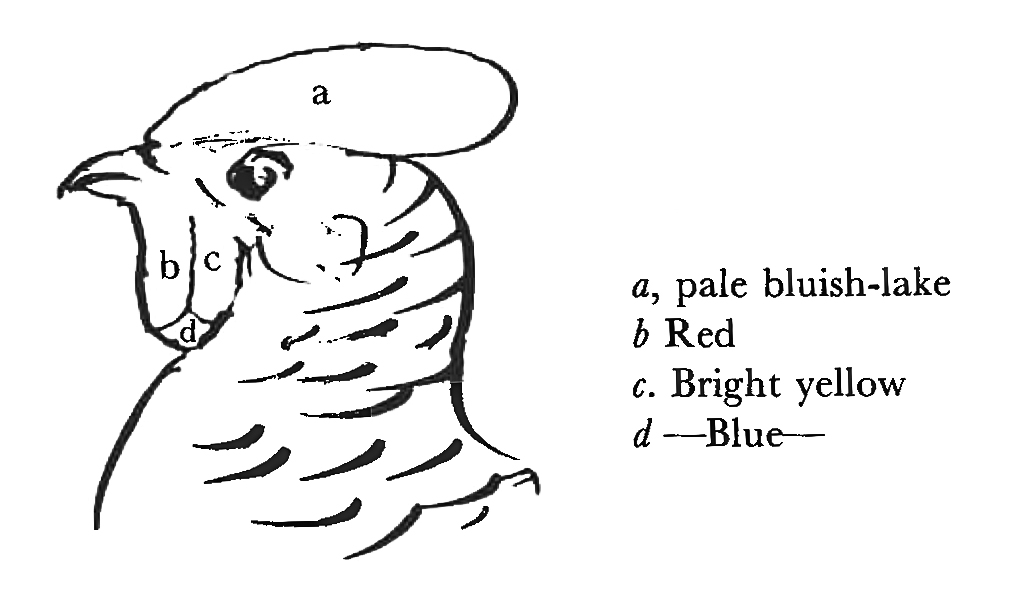 The G. œn ⟨eus⟩ of Temminck is a hybrid between this & a common hen, often enough raised in captivity in Java.— 11 Well, I have begun to work in earnest at domestic Pigeons, and am surprised to find how cheap many beautiful varieties of them are, which I will tell you more about another time; and I shall accordingly be able to send you a good supply alive £10, which you proposed to send, would more than suffice; but good (rat-proof) cages are expensive here, and I might otherwise lay out a part of the money to advantage. But I would very much rather have the value in hardy living creatures; as especially Maccaws,—and Marmozets if you could but procure some. I should be glad of any number of Maccaws, and would willingly share with you the costs and the profits of a few speculations of the kind; the latter being somewhat inordinate; but this need not be published to the world! It is a fact, that I can always get £50 a pair for Maccaws, the cost in London being £3 or 4; & they are particularly hardy on the voyage: the best plan being to send them in charge of a ship’s butcher, promising him a reward from me for all that arrive in health. For one or more pairs of Marmozets, I think that I could now get £100 per pair, without difficulty; & they go into Zenanas 12 where nobody sees them or is even likely to hear about them. Natives of enormous wealth are the purchasers, who care not what they give for what they particularly fancy; and the money is too often much worse mispent by them. Well, what say you to the spec, in a quiet way? Bartlett formerly supplied me, but since I advanced to him a considerable sum for purchases (borrowed too at high interest), I can get no answer to my letters from him, nor any account of animals which I know to have been safely delivered to him from me, the last being a fine Tibetan Bear.13 I may yet be compelled to resort to harsh measures in his case, which I am loth in the extreme to do; but not getting the Maccaws, &c, which I paid for in advance, & fully calculated on receiving and then immediately disposing of, has caused me a vast deal of trouble and annoyance, which is entirely due to Bartlett’s misconduct. Perhaps you may think such traffic infra dig.; but you might manage it by an agent; & the Commercial road is a great place to pick up Maccaws, &c. cheap; or they might be purchased of Herring & other regular dealers.— 14
But now for your letter of Decr. 16/– & its queries. About the fine Asses of the province of Omán in Arabia, I cannot recal to mind my authority for the genealogies; but I am certain that I have read it somewhere; perhaps in one of the late Lt. Wellsted’s papers, or in Burckhardt?15 But the authorities on Arabia are not numerous. You will, I suppose, have read my paper on ‘Wild Asses’, entitled Nat. Hist. Queries, by Scrap-collator, in the last No. of the Indian Sporting Review, to which I called your attention.16 Here you will find some notice of those superb donkeys; and I much incline to think now that if the genuine wild Ass still exists anywhere, it will be in S. Arabia, where Chesney speaks of a wild Ass, in addition to his “wild Horse”, the latter seeming to be the Hemione.—17 Ditto about the infertility of Irish & Devon Red Deer; my impression is, that I saw this remarked in an article in one of the English sporting periodicals; or it may have been in Chambers’s Jl, or some such work: but there is no doubt at all of my having met with the remark, & that it applied more especially to the Devon Deer. Why not try the ‘Notes & Queries’? Or make enquiry, as a correspondent of one of the sporting periodicals,—about as likely a way as any to elicit the truth. If you can get the ‘India Sporting Review’, Vol. VI, 252, you will find an interesting notice of experiments with canine hybrids:18 but the writer’s suggestion about the Hyæna is of course nonsense, inasmuch as mos eorum copulandi mos canum non est! By the way, the so called ‘Wild Dog’ I told you of is dead,19 & transferred (temporarily at least, if not permanently,), to our museum—: Hodgson saw it at Darjiling, & considers it to be totally distinct from his primævus; but I will let you know more about these rufous wild dogs (so called) after further enquiry. I am having both skin & skeleton prepared, &, as usual, the second lower tuberculous molar is wanting. What chiefly surprises me in this animal is the length of the tail, which is fully as long (as well as bushy) as any Fox’s; and there is much long hair about the jowl. I am not at all satisfied regarding the alleged facts respecting the infertility of canine hybrids in the third generation. Unless you have two or more sets of them, from different pairs of parents, the question of breeding-in-& in comes to disturb your conclusions: my own views on which question I have before explained to you— However, supposing that you had a litter of Jackal-hybrids which bred inter se, it would be easy to parallel all experiments by subjecting ordinary puppies of the same litter to precisely the same conditions; & more than one set of them, the more the better of course, to ascertain if the Jackal-hybrids really presented exceptional phenomena.20
A mere luxurious life is inimical to propagation, alike in the lower animals & in so many wealthy human families You remember the Irish medico’s remark, that sterility was hereditary in some families!! ! And also in many choice cultivated plants! The prolificacy of hybrids being of course liable to be similarly affected, & the more so as being rare and taken much care of, they are apt to be a good deal pampered. Infertility is thus a negative result, & the non-fertility of some hybrids is not necessarily due to their mixed (or mule) origin; whether the admixture be of pure species or of undoubted varieties. Nevertheless there can be no doubt of the broad fact that the tendency of hybrids is to be sterile, and especially that the semen of the males is often unprolific, & has been found (in the equine hybrid) deficient of spermatozoa. And there can be no mistake regarding my experiments with the bred Gallus Sonneratii of both sexes, which were infertile inter se, and either of them with other fowls; although the hen produced many eggs, & the cock was particularly salacious; for the eggs in which either was concerned never would hatch, although other eggs placed with them hatched as usual: & surely this instance of infertility may be fairly ascribed to the hybridity.21 Perhaps, however, other hybrids of the very same kind might be more or less prolific as some individuals of pure species are sterile.? I am going over old ground I fear; & shall finish it by telling you that I have procured some hybrid skins of the Coracias, & also of the two parent species, C. indica & C. affinis pure. For Skua Gull in both hemispheres, consult Gould’s ‘Birds of Australia’.22 It is the most striking instance of the kind I know of. The Thalassidromi Leachii was considered another; but I think this has lately been observed within the tropics. Is Gould’s Australian crested Grebe really different from that of the N. hemisphere (which I have obtained here)? I fancy not; & that several of Gould’s species want knocking on the head, ex. gr. his Sylochelidon strenuus, which = S. caspius, of which European, Indian, & Australian specimens are in our museum here, absolutely undistinguishable. Totanus glottoides, Vigors & Gould, of India & Australia is just the winter dress of T. glottis, most abundant here, & the specimens totally undistinguishable from British. The Turnstone is the most universally distributed of all birds, being found literally on all (habitable) sea-coasts; & Cynthia cardui seems to be an universally diffused Butterfly. See to Horsfield’s description of Mydaus in the Zool. Res. in Java; this species also inhabiting a certain elevation in the Malayan pena—. 23
Ever truly Yrs, E Blyth—
CD annotations
Footnotes
Bibliography
Burckhardt, John Lewis. 1829. Travels in Arabia. 2 vols. London.
Chesney, Francis Rawdon. 1850. The expedition for the survey of the rivers Euphrates and Tigris. 2 vols. London.
Correspondence: The correspondence of Charles Darwin. Edited by Frederick Burkhardt et al. 29 vols to date. Cambridge: Cambridge University Press. 1985–.
DNB: Dictionary of national biography. Edited by Leslie Stephen and Sidney Lee. 63 vols. and 2 supplements (6 vols.). London: Smith, Elder & Co. 1885–1912. Dictionary of national biography 1912–90. Edited by H. W. C. Davis et al. 9 vols. London: Oxford University Press. 1927–96.
Grote, Arthur. 1875. Introduction, being a memoir of the late Mr Ed. Blyth, C.M.Z.S., and Hon. Member Asiatic Soc. of Bengal. Journal of the Asiatic Society of Bengal 43, pt 2 (extra number, August 1875): iii–xxiv.
Humboldt, Alexander von. 1846–58. Cosmos: sketch of a physical description of the universe. Translated [by Elizabeth Juliana Sabine] under the superintendence of Edward Sabine. 4 vols. London: Longman, Brown, Green, and Longmans; John Murray.
Mitra, Rajendralala. 1885. History of the Society. Pt 1 of Centenary review of the Asiatic Society of Bengal. From 1784 to 1883. Calcutta.
Modern English biography: Modern English biography, containing many thousand concise memoirs of persons who have died since the year 1850. By Frederick Boase. 3 vols. and supplement (3 vols.). Truro, Cornwall: the author. 1892–1921.
Natural selection: Charles Darwin’s Natural selection: being the second part of his big species book written from 1856 to 1858. Edited by R. C. Stauffer. Cambridge: Cambridge University Press. 1975.
OED: The Oxford English dictionary. Being a corrected re-issue with an introduction, supplement and bibliography of a new English dictionary. Edited by James A. H. Murray, et al. 12 vols. and supplement. Oxford: Clarendon Press. 1970. A supplement to the Oxford English dictionary. 4 vols. Edited by R. W. Burchfield. Oxford: Clarendon Press. 1972–86. The Oxford English dictionary. 2d edition. 20 vols. Prepared by J. A. Simpson and E. S. C. Weiner. Oxford: Clarendon Press. 1989. Oxford English dictionary additional series. 3 vols. Edited by John Simpson et al. Oxford: Clarendon Press. 1993–7.
Post Office London directory: Post-Office annual directory. … A list of the principal merchants, traders of eminence, &c. in the cities of London and Westminster, the borough of Southwark, and parts adjacent … general and special information relating to the Post Office. Post Office London directory. London: His Majesty’s Postmaster-General [and others]. 1802–1967.
Variation: The variation of animals and plants under domestication. By Charles Darwin. 2 vols. London: John Murray. 1868.
Summary
Opposition to EB within the Asiatic Society.
Possibility of establishment of a zoological garden at Calcutta.
Has seen Gallus varius alive for the first time.
Will procure domestic pigeons for CD; could CD pay for them by returning hardy creatures, such as macaws and marmosets, which EB can sell for a high price in India?
Does not recall his authority for genealogy of the asses of Oman. If a genuine wild ass exists EB believes it will be in south Arabia.
Infertility of Irish and Devon red deer.
Details of an unusual species of wild dog.
Fertility of canine hybrids. General tendency toward hybrid sterility.
Has skins of hybrid Coracias and the parent species.
Wide-ranging species; skua found in Europe and Australia, but not in the tropics.
Letter details
- Letter no.
- DCP-LETT-1832
- From
- Edward Blyth
- To
- Charles Robert Darwin
- Sent from
- Calcutta
- Source of text
- DAR 98: A128–A132
- Physical description
- ALS 10pp †
Please cite as
Darwin Correspondence Project, “Letter no. 1832,” accessed on
Also published in The Correspondence of Charles Darwin, vol. 6