
From Edward Blyth 21 April 1855
Calcutta,
April 21/55—
My dear Sir,
I have the pleasure to acknowledge receipt of yours of the 27th. February,1 and am much gratified to learn that a subject in which I have always felt the deepest interest has been undertaken by one so competent to treat of it in all its bearings.2 I should have much to say upon it, but can with difficulty find time even to write, and have no leisure just now to reflect upon it as I could wish. The subject of the races of domestic animals has never yet been fairly taken up with reference to Ethnology, upon which it is not unlikely to throw some important lights. Pray excuse the loose & desultory way in which absolute want of leisure compels me to express the ideas that occur to me— Would it not be interesting, for instance, to know the precise races of domestic fowls that were found by the old navigators in certain of the S. Sea islands, & even I believe in Peru?
Then, we have the peculiar Dog of Australia, & a distinct race in N. Zealand; the only non-marsupial land animals except Cheiroptera & murine rodents ; & it is worthy of notice that the only two known indigenous mammals of N. Zealand are a Bat & a Rat, though I have seen some newspaper notice of a Badger-like animal having been observed, most likely a marsupial, if anything! The Dogs of those countries have therefore been most probably introduced, & what Dogs in other regions do they most resemble? The Chinese Dog, commonly eaten, is one: See White’s Selbourne.3 The C. rutilus group is peculiar in wanting the 2d. lower true molar, which the Dingo possesses. One important fact is, that the domestic animals of the New World were indigenous, & the origin of the tame races lost in antiquity, as with most of those of the Old world. Even the Guinea-pig was found in its present domestic state, I believe, roaming about the huts of the Guinea savages, & is not quite satisfactorily referred to any wild species. N.B. I observe that some of the Guinea-pigs here show a tendency to enlargement of the ear-conch. I know but of 3 domesticated rodents, & the others are the Rabbit & the common Mouse, the origins of which are obvious. We have neither here, except a very few no doubt imported by Europeans & which have not multiplied much! In fact, I suspect that neither are much seen away from the ports. The common house Mouse of India is an obviously distinct species from that of Europe, & has not been bred in domestication— Now back to America. The Spaniards have the credit of introducing the Turkey into Europe, but they found it already domesticated in Hayti, & Montezuma fed the Carnivora in his menagerie upon the flesh of tame Turkeys.4 It is not, then, as popularly supposed, a bird recently domesticated by civilized man: but it is more thoroughly domesticated than the Peafowl and the Guinea-fowl of the East, which are scarcely more so than the British Pheasant (they certainly do not vary more), or the Fallow Deer of English parks! I am not sure that an ordinary British farm-yard Peacock or hen could be distinguished from the wild bird, unless the leg be somewhat coarser. Send me, if you can, some tame Peafowl legs for comparison.5
Do you not think it probable that the Llama & Alpaca descend from the Huanaco? Certainly the Vicugna must be a distinct species.6 In the North, we have the Arctic Wolf passing imperceptibly into the Esquimaux Dog, and this into the Newfoundland. Now I especially recommend the history of the Newfoundland Dog to your study. It is a marked-race, I suspect developed since the discovery of the N. World. Nought like it has been seen among the Red Men, that I am aware of; but see what Col H Smith says of it, in his Vol. on Dogs in Jardine’s Nat. Library.7 Well, the Canis latrans is said to pass into the ‘Hare Indian Dog’, & that this & the Esquimaux Dog readily interbreed, while the wild Wolves remain distinct. But Sir John Ross (I think it is) relates how a Newfoundland bitch of his habitually played with the Wolves that came about the ship, & if I mistake not was lined 8 by one;9 so here is nought of the antipathy between Wolf & Dog so insisted upon by Buffon,10 & which of course is the result of education. Again, I have read somewhere, that when a backwoodsman comes upon a young Wolf suddenly, he makes a loud holloabaloo, & the little thing crouches at his feet for fear, like a Spaniel; when the man seizes the opportunity to decapitate (as you took unfair advantage of the poor Fox in Chiloe!11 ) Suppose now that, instead, he were to pat & encourage it? Might it not become attached & follow him, & in fact become his dog! In the great plains of the Puzztas in Hungary, some of the most valuable flocks in the world are entrusted to the charge of Dogs, which are so little removed from the neighbouring Wolves, that instances happen of sportsmen shooting their own Sheep dog in mistake for a Wolf, for which reason a black breed is fostered, to prevent such mistakes. Yet these faithful guardians of the flocks do not bark, & retain all the sneaking habits of the Wolf. Vide Paget’s Travels in Hungary & Transylvania.12 Here, in India, the Pariah Dog & Jackal occasionally interbreed, instances having occurred within my knowledge;13 and I have seen a dog undistinguishable from the Esquimaux Dog brought down by the Bhooteeas (or Tibetans), along with Tibet Mastiffs. Indeed, what else can be the sledge Dogs of Siberia, mentioned & employed by Von Wrangell & others?14 To make a short digression, the name Tibet was unknown in the actual country till lately, where it has been introduced by Goláb Singh’s people!15 The country, however, is styled Bhote in India, & there is the province of Bhoot an or Butan, enabling us to recognise the second syllable of Tibet. Is not the Tibetan Mastiff a development of the T. Wolf, as the Newfoundland Dog is of the Arctic, & the St. Bernard’s dog of the European W? N.B. All the largest Dogs are from cold climates, & all dogs tend to revert to the wild type in hot climates. But how about the Cuba mastiff? You will infer that I quite adopt Desmoulin’s theory of the origin of domestic dogs, en masse.16
The only other domestic Carnivora are the Cat and the Ferret, which latter is clearly enough a tamed Polecat. In India, the Cats (tame) are smaller than the English, & the tail is slender but not tapering. The prevalent colour is plain cat-grey, with no markings except on the limbs & tail, much as in F. chaus (which however is quite distinct, much larger, with shorter tail, &c). Sometimes the dark stripes occur all over the body, as commonly in British Cats; but the proper tabby, pale markings on a black ground, never occurs , nor does the plain grey ever occur among British Cats. Black & white & Tortoise-shell varieties occur in each, the latter in the female sex only (with exceedingly rare exceptions), their representatives in the male sex being those buff-coloured Cats, which seem to be invariably males. The proper colour of the Angola Cat is streakless grey on the body, like the Indian; F. maniculata is affined, but not certainly identical; also F. rubiginosa of the Coromandel coast; & a Cat from Afghanistan & the Punjab Salt Range which I have termed F. Huttoni. The British Cats seem to derive partly from the Wild Cat of the country, which I suspect interbred so largely as to influence the characters of the race, at a time when tame Cats were few in Britain, & the wild species far more numerous than at present. Instances have occurred of the Indian tame Cat interbreeding with F. chaus & with F. rubiginosa.17 So much for puss.
Other Carnivora which have been tamed & trained for hunting or fishing, as Hawks and Cormorants likewise are, are Felis jubata, F. caracal, Lutra chinensis (here), and I believe Seals. Otters are extensively trained for fishing in the S.E. of Bengal as Cormorants are in China— You will of course treat largely of cultivated plants, and of the utter bedevilment of some Genera, as Rosa, by the horticulturists,—also Citrus, Erica, Pelargonium, &c &c—
Among insects the silkworm only seems thoroughly domesticated; & I call your attention to this fact, that Bombyx mori continues breeding, generation after generation, throughout the year in India, i.e. the Indian variety; while in Silk worms imported from Europe or China, the eggs will only hatch at a particular season. A friend of mine has been experimenting by crossing the races,18 in the endeavour to combine the superior silk of one with the frequent generations of the other.— Of other insects, the Cochineal affords the only approach to domestication (known to me), but I am far from satisfied that that the Grana fera & the Grana sylvestris are not distinct species, as this term is commonly understood.
Of fish, there seems only to be the Cyprinus auratus, of which I take C. macrophalmus to be probably but an extraordinary variety. The other varieties in colour & form are most interesting, especially the variation of the fins— It would seem that certain Indian Cyprinidæ also tend to vary, for which vide Mc Clelland’s paper on the fishes of Asám in the ‘Asiatic Researches’.19
Among Insessorial birds, the only domesticated species is the Canary-bird, of which the generic or subgeneric type, Crithagra, Swainson, is strictly African. The Wild type of Madeira & the Canary islands merits particular study, as being undoubtedly the true origin of all the domesticated races. For prolific hybrids between these & other Finches, vide Mag. Nat. Hist. V, 424.20 I observe that Fortune in his 2d. work (on the Tea-districts of China & India) speaks familiarly of Canary-birds in the interior of the North of China;21 so that it would seem that they are there propagated. Enquire of himself. Here they are few in number & do not thrive, though continually imported. —While upon Insessorial birds, is not Corvus corone a melanoid variety of C. cornix ? I have an intermediate variety from Norway. Corvus splendens from Mergui & from Ceylon is much darker than A. in Bengal & India generally; so also Acridotheres tristis from Ceylon. Again, what is Corvus spermologos, auct, but a melanoid Jackdaw? I cannot now go into the subject of local races, the line between which and acknowledged species it is impossible to trace or demarcate. Schlegel goes to the extent of considering the Himalayan Jay (G. ornatus) to be a variety of the European:22 if so, there is an end to all distinction of species: & in fact, if we argue for an independent origin (or creation) of each race, we are necessitated to admit that aboriginal, distinct races do not necessarily differ at all; for instance a certain tropical Butterfly, Papilio nomius, found in Bengal & in Brazil! &c &c &c.
The capability of hybrids for propagation is a curious subject of enquiry, replete with irreconcilable facts. Thus some genera, both of plants & animals, produce mutually prolific hybrids, in every degree; e.g the various Wolves, Dogs, & Jackals; Bos taurus & Bos indicus. In the Zoological Gns, there was formerly a beast that combined the Donkey, Zebra, and Quagga;23 and I have there seen birds that were fowl, & pheasant! On the other hand, I myself raised a pair of hybrids from the male Gallus Sonneratii, and a female common fowl, as like the wild-hen bankivus as I could find. Very many (more than 100) of these hybrids were hatched, but only one pair attained maturity. The cock was particularly salacious, & the hen produced a great number of eggs, by common cock, by hybrid cock, and by Sonnerati; yet none of these ever hatched, nor eggs of common-hen trodden by the hybrid!24 Though others, marked & placed with them, hatched as usual. Yet I have seen birds bred between common fowl & pheasant!
It is easy to dogmatize & say that Bos indicus is but a humped variety of B. taurus, but the hump is but one of many differential characters, though seen very early in fœtal life!25 The voice is totally different, & so are the habits; B. indicus never seeking shelter from the hottest Bengal sun, & never standing knee & belly deep in water, as pictured in Thompson’s ‘Summer’.26 I am not even sure that B. indicus is Indian, rather than African aboriginally. It is the tame ox of the pastoral Fellatah nations of middle Africa from E to W., & also of Madagascar, where Pennant states that there is a wild humpless race termed Boury.27 Again, no fossil or semi-fossil remains of the Humped Ox have hitherto been met with here. Both it & the European Ox are represented in Egyptian paintings & monuments, & then again we have the humpless caffre cattle (with wide-spreading horns) in S Africa, to account for. A race demanding particular study. It would be well if we could get to understand the wild bulls which were hunted by the old Assyrian Kings. There is a peculiarity in the European form of Taurines (including primogenius), to which I call your attention. It is that the horns typically curve forwards & then up: in other bovines they do not typically advance beyond the plane of the forehead
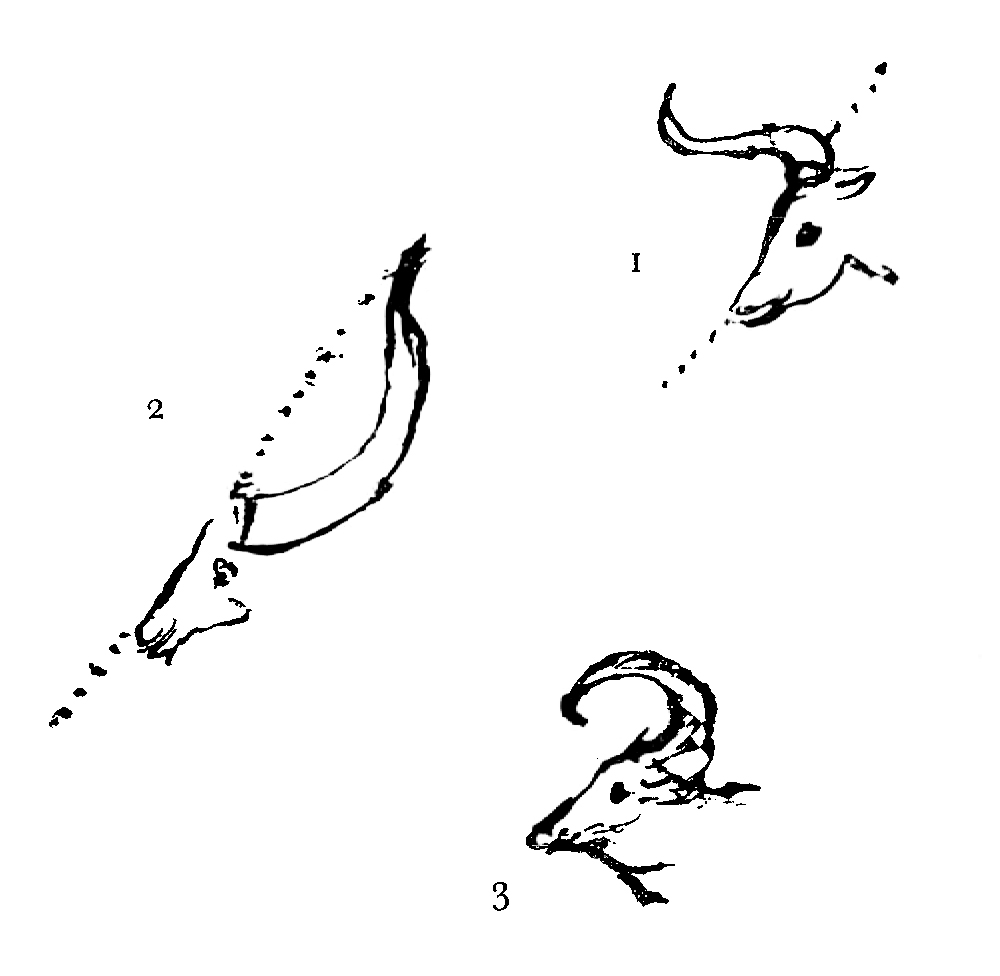 1. European type,— 2, Buffalo, Bison, Yak, humped cattle, Gasur, Gayal, Banteng, &c— 3 Abnormal humped Ox, never out and up, as in European, but forward and down. The huge Bornonese race are thus, enormously thickened, vide species in British Museum. Observe also that in B. taurus & B. indicus, the horns of the bull are short and stout, in the Ox and cow much longer; but in primogenius the horns of the bull are longer as well as thicker than in the cow! Qu. is the immense & beautifully symmetrical cow skull in the Br. Museum, figured by Owen as primogenius,28 truly referable to that species? The derivation of the Highland cattle from longifrons seems probable; but how about the noble Tuscan cattle, & other large breeds? Nilsson’s species I fear is a dead failure!29 For a most interesting fact regarding the domestication of cattle upon a large scale, in modern & even present times, see the various accounts of the Gayal, Bos frontalis not gavæus, in the Asiatic Researches, & Lin Transactions—30 There you have the gradual transition into domesticity without loss of liberty & the novel scenes of the farmyard and of the vicinage of the abodes of civilized mankind. I am not well situated for making observations on the breeds of cattle in India. The larger all come from the West; & the Galla cattle of Bruce and Salt,31 and the thick-horned Bornonese, are evidently merely varieties of the humped Ox. This animal has gone wild in herds in parts of Oudh; maintaining its race against Tigers & other Carnivora. I have seen Oxen in Madras with horns comparable with those of the Galla oxen.— The domestic Buffalo of Italy and Hungary is a very different animal from that here, with more pointed convex forehead, short horns (vide Cuvier Oss. fossiles),32 & tail with its tuft reaching to the ground. I believe that this race is also found in Sindh. Those of the Egyptian Delta are the same as the tame Buffalos here. It seems that wherever this animal is introduced, it has a strong tendency to revert to wildness, as in the delta of the Nile, parts of the Malayan archipelago & peninsula, & even the neighbourhood of Pt. Essington in N. Australia. There is a small Philippine race, which I saw, also in the Z. gardens; & the Z. S. museum contains a stuffed specimen. I cannot now go into the subject of Sheep and Goats. The allusions to Sheeps’ tails (fat of the tail) in Leviticus shew that the Hebrew legislator intended ‘Doombahs’.33
Of Horses, I will only say that Pallas’s figure of a Wild Horse represents a young colt,34 as shewn by the tail, & that I am not satisfied of the existence of an aboriginally wild race. Ditto, the Wild Ass of Gmelin,35 which is evidently a hemionus with an incipient cross-stripe: this I have seen (but a less extent) in the ‘Ghor-Khur’ of W. Asia, Sindh, &c, in the Surrey Z. gardens.36 The Indian Donkeys are very diminutive & ill made, ‘cat hammed’ exceedingly. Their legs are often much striped, & additional stripes or even broad transverse bands on the body, to the number of three or four, sometimes (though rarely) appear; a succession of distantly placed stripes, more or less lengthened. Pigs I must also pass over, though a fertile subject.
The tame ringed Turtle Dove is an antique race, as shewn by our friend Mr. Dixon,37 & I do not believe that it derives from the wild Indian risorius ; from its great difference of voice. Of 5 nearly affined species before me, Swainson’s smaller race (vide Birds W. Africa)38 seems to have the best claim to be considered its origin. In three African races before me, the black collar is much broader than in the Indian risorius, or Malayan bitorquatus ; & the tame Turtle-dove has the same broad black collar as all the African Of Pigeons, I can only now state generally, that I have reason to believe that all the ‘fancy’ breeds originated in the east, where too they are variously combined, in manner that I have never seen in Europe; but I am not well situated for making enquiries. The investigator of the breeds of Pigeons should reside at Lucknow, or Delhi, & might even study them (I suspect) advantageously at Baghdad, or Isfahán. We cannot get to see the finest specimens here. I may add, that I cannot help doubting exceedingly the statement, in the Appendix to Salt’s Travels, that the C. Guinea, a thorough arboreal form of Pigeon, is the common domestic Pigeon of Abyssinia.39 In India, we see vast numbers of Pigeons, semi-wild, & breeding in buildings of all sorts. These are of the race called intermedia by our lamented friend Strickland,40 but are simply a local race of livia, differing from the European bird in not having the rump white.41 These flocks shew more or less variation in colour, some being white or pied, but the majority are true to their colouring, & have grey rump. A white rump is rare, & sometimes it is more or less albescent. Sometimes too the wings are speckled instead of barred. It is as impossible not to see in them the origin of the common tame Pigeons of India, as I should have thought it impossible not to recognise in the Mallard the origin of the tame Duck, & in the Bengal Jungle fowl that of “the Fowl”. In each case the plumage is a strong indication. So with the British Domestic Goose & the Grey lag; yet the Grey lag is here common in the wild state, while all the tame Geese here have much of the A. cygnoides in their composition. In Upper India, I am assured that all or most of the tame Geese are pure cygnoides; a most distinct species, unknown in the wild state. It is curious that both the tame Goose & Duck in Europe should exhibit a variety or race with downy tuft on occiput. Here neither Ducks nor Geese exhibit much variation, beyond the ordinary differences of colour. Although the Mallard does not occur here, the domestic Ducks retain the characteristic markings of that bird; but the wild Mallard occurs on the Himalaya & along the Indus. The ‘Musk’ Duck is an instance of a bird now ⟨gradually⟩ passing into varieties. In With reference to what I have said of the sterility of my hybrids of G. Sonneratii, it is curious that different species of the Kallij Pheasant (Gallophasis) interbreed freely in the wild state, & produce specimens of every grade of intermediate.42 Yet as species they appear to be well distinguished one from another.
I have now, I fear, pretty well tired you, but may perhaps have thrown out a suggestion or two that may be useful, which will amply compensate me for the time devoted to this hasty scrawl, for such it truly is. I will send you a Jungle cock skeleton by first opportunity, & with kindest regards, | I remain | Most truly Yours, | Edd. Blyth
CD annotations
Footnotes
Bibliography
Birds: Pt 3 of The zoology of the voyage of H.M.S. Beagle. By John Gould. Edited and superintended by Charles Darwin. London: Smith, Elder and Co. 1839–41.
Blyth, Edward. 1856. Curator’s report for the August meeting, 1856. Journal of the Asiatic Society of Bengal 25 (1857): 439-49. [Vol. 5]
Bruce, James. 1813. Travels to discover the source of the Nile, in the years 1768, 1769, 1770, 1771, 1772, & 1773. 3d ed. 7 vols. Edinburgh.
Buffon, Georges Louis Leclerc, comte de. 1830. The natural history of quadrupeds … translated from the French. 3 vols. Edinburgh.
Cookson, George. 1840. Propagation by hybrids. Annals of Natural History 5: 424–5.
Correspondence: The correspondence of Charles Darwin. Edited by Frederick Burkhardt et al. 29 vols to date. Cambridge: Cambridge University Press. 1985–.
Cuvier, Georges. 1834–6. Recherches sur les ossemens fossiles, où l’on rétablit les caractères de plusieurs animaux dont les révolutions du globe ont détruit les espèces. 4th edition. 10 vols. and 2 atlases. Paris: E. d’Ocagne.
Dixon, Edmund Saul. 1851. The dovecote and the aviary: being sketches of the natural history of pigeons and other domestic birds in a captive state, with hints for their management. London: John Murray.
Fortune, Robert. 1852. A journey to the tea countries of China. London.
Journal of researches: Journal of researches into the geology and natural history of the various countries visited by HMS Beagle, under the command of Captain FitzRoy, RN, from 1832 to 1836. By Charles Darwin. London: Henry Colburn. 1839.
Lambert, Aylmer Bourke. 1804. Further account of the Bos frontalis. Transactions of the Linnean Society of London 7: 302–5.
McClelland, John. 1839. Indian Cyprinidæ. Asiatick Researches 19, pt 2: 217–465.
Natural selection: Charles Darwin’s Natural selection: being the second part of his big species book written from 1856 to 1858. Edited by R. C. Stauffer. Cambridge: Cambridge University Press. 1975.
Nilsson, Sven. 1849. On the extinct and existing bovine animals of Scandinavia. Annals and Magazine of Natural History 2d ser. 4: 256–69, 349–55, 415–23.
Notebooks: Charles Darwin’s notebooks, 1836–1844. Geology, transmutation of species, metaphysical enquiries. Transcribed and edited by Paul H. Barrett et al. Cambridge: Cambridge University Press for the British Museum (Natural History). 1987.
OED: The Oxford English dictionary. Being a corrected re-issue with an introduction, supplement and bibliography of a new English dictionary. Edited by James A. H. Murray, et al. 12 vols. and supplement. Oxford: Clarendon Press. 1970. A supplement to the Oxford English dictionary. 4 vols. Edited by R. W. Burchfield. Oxford: Clarendon Press. 1972–86. The Oxford English dictionary. 2d edition. 20 vols. Prepared by J. A. Simpson and E. S. C. Weiner. Oxford: Clarendon Press. 1989. Oxford English dictionary additional series. 3 vols. Edited by John Simpson et al. Oxford: Clarendon Press. 1993–7.
Origin: On the origin of species by means of natural selection, or the preservation of favoured races in the struggle for life. By Charles Darwin. London: John Murray. 1859.
Paget, John. 1839. Hungary and Transylvania; with remarks on their condition, social, political, and economical. 2 vols. London: John Murray.
Pallas, Pyotr Simon. 1774. Equus Hemionus, Mongolis Dshikketaei Dictus. Novi Commentarii Academiae Scientiarum Imperialis Petropolitanae 19: 394–417.
Pallas, Pyotr Simon. 1798. Description of the Equus Hemionus or Dshiggetai of the eastern deserts of Middle Asia. [Translation]. Philosophical Magazine 2: 113–21, 234-40.
Prescott, William Hickling. 1843. History of the conquest of Mexico, with a preliminary view of the ancient Mexican civilization, and the life of the conqueror, Hernando Cortés. 3 vols. London.
Salt, Henry. 1814. A voyage to Abyssinia, and travels into the interior of that country. London. Facsimile reprint. London: Frank Cass and Company. 1967.
Schlegel, Hermann. 1843. Essay on the physiognomy of serpents. Translated by Thomas Stewart Traill. Edinburgh.
Schreber, Johann Christian Daniel von. 1778–1846. Die Säugethiere in Abbildungen nach der Natur mit Beschreibungen. Continued by Johann Andreas Wagner. 7 vols. Erlangen: Expedition des Schreber’schen säugthier- und des Esper’schen schmetterlingswerkes.
Smith, Charles Hamilton. 1839–40. The natural history of dogs: Canidæ or genus Canis of authors. Including also the genera Hyæna and Proteles. 2 vols. (Vols. 4 and 5 of Mammalia in The naturalist’s library, edited by William Jardine.) Edinburgh: W. H. Lizars.
Swainson, William. 1837. The natural history of the birds of western Africa. 2 vols. Vols. 22 and 23 of Jardine, William, ed., The naturalist’s library. 40 vols. Edinburgh. 1843.
Thomson, James. 1727. Summer. A poem. London.
Variation: The variation of animals and plants under domestication. By Charles Darwin. 2 vols. London: John Murray. 1868.
White, Gilbert. 1789. The natural history and antiquities of Selborne, in the county of Southampton. 2 vols. London.
White, Gilbert. 1825. The natural history of Selborne. New edition. 2 vols. London: C. an J. Rivington [and others].
Wrangel, Ferdinand von. 1844. Narrative of an expedition to the Polar Sea, in the years 1820, 1821, 1822 & 1823. 2d ed. [Translated by Elizabeth Juliana Sabine.] Edited by Edward Sabine. London.
Summary
Indigenous domestic animals of the New World.
Relationship of Newfoundland and Esquimo dogs to the wolf. Dogs like the Esquimo occur in Tibet and Siberia. Indian pariah dogs and jackals occasionally interbreed.
Describes domestic cats of India; reports cases of their interbreeding with wild cats. Wild cats are tamed for hunting.
Races of silkworm in India are crossed [see 1690].
Domesticated plants, fish, and birds of India.
Comments on local races and species of crows; it is impossible to trace a line of demarcation between races and species.
Variation in the ability of hybrids to propagate.
Indian cattle breeds; differences between Bos indicus and Bos taurus.
Is not satisfied that aboriginally wild species of horse and ass exist.
Believes all fancy breeds of pigeon originated in the East. Wild ancestors of pigeons, ducks, geese, and fowls. Interbreeding of wild species of pheasant.
[CD’s notes are an abstract of this letter.]
Letter details
- Letter no.
- DCP-LETT-1670
- From
- Edward Blyth
- To
- Charles Robert Darwin
- Sent from
- Calcutta
- Source of text
- DAR 98: A57–A68
- Physical description
- ALS 24pp †, CD note 8pp
Please cite as
Darwin Correspondence Project, “Letter no. 1670,” accessed on
Also published in The Correspondence of Charles Darwin, vol. 5