
To Albany Hancock 10 January [1853]1
Down Farnborough Kent
Jan 10th—
My dear Sir
I am uncommonly obliged to you for taking so much trouble as to write at such length to me; though in truth when I think of your many important pursuits in Nat. History, I am ashamed to have lost you more than one good hour of time.— Your cautions & suggestions will be of considerable service to me, as leading to fresh observations & making me explain some points more clearly. I will not take up your time in going into several points you notice in this letter, but they shall all be more or less attended to in my Book.2 I may just inform you, that when a ribbed shell is cut through, it can be seen that the marginal erosion does not graduate into the central hollow:
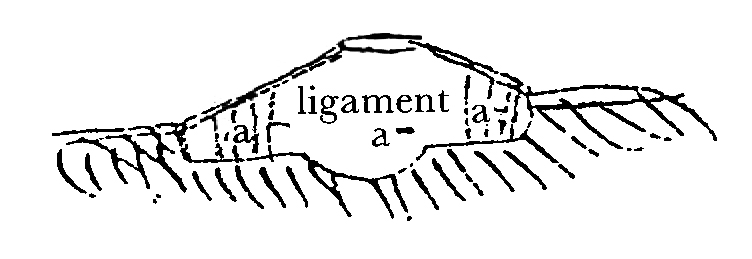 indeed if whole base was simultaneously being eroded it is hard to see how basals membrane & shell cd be firmly attached. I quite agree that more specimens on calc: & non calc: supports shd. be examined, & I will write to a naturalist in Devonshire3 to collect for me: I think, however, you did not understand that there were several specimens on the two slate-rocks & hundreds on the Laminariæ.—
I am quite delighted at what you say about my little friends, the complemental males; I greatly feared that no one wd believe in them; & now I know that Owen, Dana & yourself are believers, I am most heartily content. I entirely agree with you on your remarks on cross-impregnation— some years ago I set to work to collect facts on this head, but I have as yet done nothing with them:4 such view as yours is the only foundation, I am well convinced, to Steenstrup’s rather wild Memoir5 on the non-existence of Hermaphroditism in Nature,—though he extends the doctrine to mere physical organs!6
Many thanks for the wretched M.S. returned:7 I am quite sorry I asked for it, for I never dreamed that you had not long ago got what little good you could out of it: I ⟨ ⟩ be pleased at your doing whate⟨ver⟩ you ⟨ ⟩ with my specimens, &c. You sha⟨ll⟩ hear, when I have gr⟨ ⟩ with Alcippe:8 the other evening I read over your Paper9 & could not get to sleep for hours, from thinking of its curious & anomalous structure: I have some other specimens of yours.—
With my sincere thanks | Believe me, my dear Sir, Yours sincerely | C. Darwin
Footnotes
Bibliography
Collected papers: The collected papers of Charles Darwin. Edited by Paul H. Barrett. 2 vols. Chicago and London: University of Chicago Press. 1977.
Correspondence: The correspondence of Charles Darwin. Edited by Frederick Burkhardt et al. 29 vols to date. Cambridge: Cambridge University Press. 1985–.
Living Cirripedia (1854): A monograph of the sub-class Cirripedia, with figures of all the species. The Balanidæ (or sessile cirripedes); the Verrucidæ, etc. By Charles Darwin. London: Ray Society. 1854.
Notebooks: Charles Darwin’s notebooks, 1836–1844. Geology, transmutation of species, metaphysical enquiries. Transcribed and edited by Paul H. Barrett et al. Cambridge: Cambridge University Press for the British Museum (Natural History). 1987.
Steenstrup, Johannes Japetus Smith. 1846. Untersuchungen über das Vorkommen des Hermaphroditismus in der Natur. Ein naturhistorischer Versuch. Translated from the Danish by Dr C. F. Hornschuch. Greifswald.
Summary
Grateful for AH’s long letter and suggestions. Delighted at what he says about "complemental males". CD feared no one would believe in them but now that Owen, Dana, and AH accept them, he is content.
Agrees with AH on cross-impregnation; has collected facts on this head but has done nothing with them.
AH’s paper on Alcippe [Ann. & Mag. Nat. Hist. 2d ser. 4 (1849): 305–14] caused him to lose sleep over its anomalous structure.
Letter details
- Letter no.
- DCP-LETT-1497
- From
- Charles Robert Darwin
- To
- Albany Hancock
- Sent from
- Down
- Source of text
- Historical Society of Pennsylvania
- Physical description
- ALS 4pp damaged
Please cite as
Darwin Correspondence Project, “Letter no. 1497,” accessed on
Also published in The Correspondence of Charles Darwin, vol. 5