
To Robert Fitch 15 January [1850]
Down Farnborough Kent
Jan 15th.
My dear Sir
I must send one line to thank you for the truly kind way you take the accident to your specimen.— I have now mended it; there were 13 fragments, but they fit so well that with the head 18 inches or two feet off, the injury cannot be perceived, & the specimen is as good as ever for Scientific purposes.— I am very grateful for your offer, of a duplicate; but I must tell you that as soon as my monograph is completed, I shall give all my specimens to Brit. Mus.1 Possibly the fossil species may be published by Palæntog. Soc.—2
Your specimens3 consist of (1st) the Scalpellum fossula (as I intend to call it, if I find that it has been nowhere described) its affinities I have correctly given you.—4 Your specimens contain all the valves except one or two: there is a large single
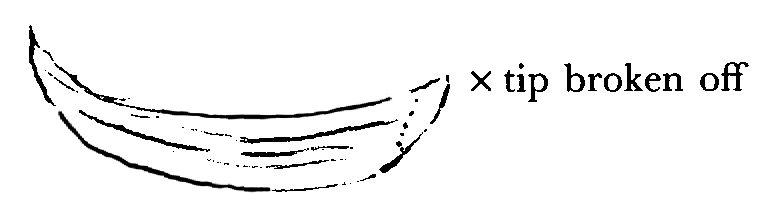 unsymmetrically curved;5 this is, I believe, a right-hand anterior latera of lower whorl, & correspond to the valve missing in your specimens, but if so the species must have attained a great size. The only other specimen, I have seen, of S. fossula is a right hand broken scutum in Mr J. Sowerby’s collection from Norwich.
Secondly you have a Carina of the Scalpellum (Pollicipes) Sulcatum of Sowerby.6
Thirdly there is a right-hand scutum of a Scalpellum (the one broken & repaired), probably the S. (Pollicipes) maximum of J. Sowerby.—
Fourthly you have a pair of Terga of a Pollicipes, I believe new spec.—
I will attend to all your wishes about the specimens: you need not doubt my referring for my own sake (independently of gratitude) to your Collection, as place of deposit of specimens described. How I wish I cd see a few more specimens even with two valves together: there is always a risk in describing separate valves of making several nominal species out of one. If you have any oddly shaped, curled valves they wd be very interesting to me; indeed the more I see the more likely I am to come to correct conclusions—
I can generally now tell the position of a separate Valve, even when the other valves are quite unknown: Judging from the keel valve alone, I think that I have now before me five species of cirripedia from the Chalk. & at least as many more from the Gualt.—
But I am troubling you with details. If I had plenty of specimens I might perhaps make out as many species from the other valves as from the Carina or Keel valve.—
Pray believe me | Yours sincerely obliged | C. Darwin
I forgot to say, that in examining the Boxes sent, I see one has been crushed in the corner & that injury not produced by any jar, & therefore I hope that your specimens will go back quite safe in wooden Box
P.S.7 I have opened my letter to say that I have been at work on your specimens, & know from analogy that the single keel-valve specimen of S. sulcatum; has a third lower side in the upper half entirely hidden in the chalk: your specimen is exteriorly more perfect than any I have seen, yet I cannot have it drawn without I cd exhibit this lower side in upper half:= I am sure I cd clear chalk from it with safety on one side, as I have done with Mr Sowerby’s specimens. At present the chief characteristic of your valve is hidden.— I enclose envelope directed to save your time: will [you] write word, "yes" or "no" on slip of paper & no more & I will act accordingly.—
I am sorry to say that I have this morning heard from my Brother in London that his house is full & he cannot receive me next week from this cause & from my wifes confinement I fear I must put off going to London for a week more. I pledge my honour nothing but good reason shall delay me having your specimens drawn & returned.
I really apologise for length of this note.
Footnotes
Bibliography
Fossil Cirripedia (1851): A monograph on the fossil Lepadidæ, or, pedunculated cirripedes of Great Britain. By Charles Darwin. London: Palaeontographical Society. 1851.
Fossil Cirripedia (1854): A monograph of the fossil Balanidæ and Verrucidæ of Great Britain. By Charles Darwin. London: Palaeontographical Society. 1854.
Trenn, Thaddeus J. 1974. Charles Darwin, fossil cirripedes, and Robert Fitch: presenting sixteen hitherto unpublished Darwin letters of 1849 to 1851. Proceedings of the American Philosophical Society 118: 471–91.
Summary
Discusses fossil cirripede specimens from RF’s collection. Comments on problems of describing their valves.
Letter details
- Letter no.
- DCP-LETT-1291
- From
- Charles Robert Darwin
- To
- Robert Fitch
- Sent from
- Down
- Source of text
- Norwich Castle
- Physical description
- ALS 10pp
Please cite as
Darwin Correspondence Project, “Letter no. 1291,” accessed on
Also published in The Correspondence of Charles Darwin, vol. 4